qualifying test scores to qualify for a medical study, an applicant must have a systolic blood pressure in…
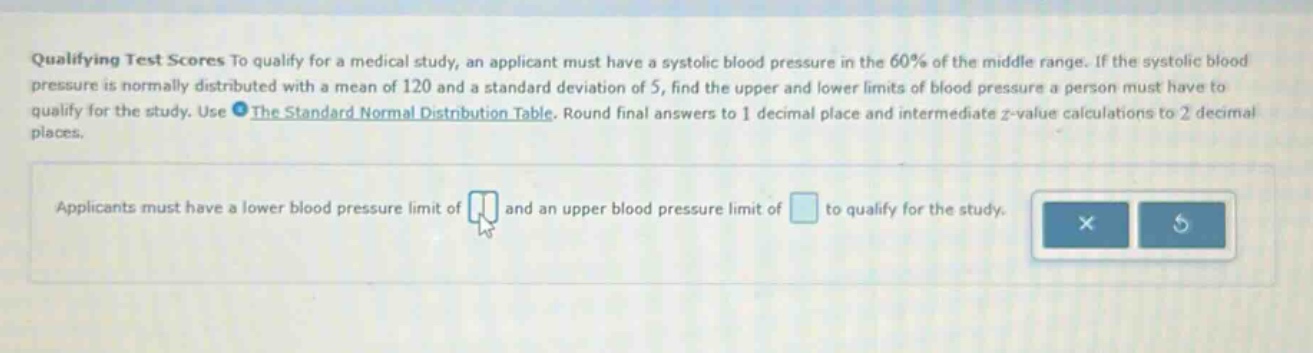
qualifying test scores to qualify for a medical study, an applicant must have a systolic blood pressure in the 60% of the middle range. if the systolic blood pressure is normally distributed with a mean of 120 and a standard deviation of 5, find the upper and lower limits of blood pressure a person must have to qualify for the study. use the standard normal distribution table. round final answers to 1 decimal place and intermediate z - value calculations to 2 decimal places. applicants must have a lower blood pressure limit of and an upper blood pressure limit of to qualify for the study.
Answer
Explanation:
Step1: Determine the area outside the middle range
The middle range is 60% or 0.6. The area outside the middle range is $1 - 0.6=0.4$. Since the normal - distribution is symmetric, the area in each tail is $\frac{0.4}{2}=0.2$.
Step2: Find the z - scores
The area to the left of the lower z - score is $0.2$, and the area to the left of the upper z - score is $1 - 0.2 = 0.8$. Looking up in the standard normal distribution table, the z - score corresponding to an area of 0.2 is approximately $z_1=- 0.84$ and the z - score corresponding to an area of 0.8 is approximately $z_2 = 0.84$.
Step3: Use the z - score formula to find the blood - pressure limits
The z - score formula is $z=\frac{x-\mu}{\sigma}$, where $x$ is the value from the original distribution, $\mu$ is the mean, and $\sigma$ is the standard deviation. We know that $\mu = 120$ and $\sigma = 5$. For the lower limit: [ \begin{align*} -0.84&=\frac{x_1 - 120}{5}\ x_1-120&=-0.84\times5\ x_1&=120- 4.2\ x_1&=115.8 \end{align*} ] For the upper limit: [ \begin{align*} 0.84&=\frac{x_2 - 120}{5}\ x_2-120&=0.84\times5\ x_2&=120 + 4.2\ x_2&=124.2 \end{align*} ]
Answer:
Lower blood - pressure limit: 115.8, Upper blood - pressure limit: 124.2