question 20\n2 pts\nfind the area of the shaded region. the graph depicts the standard normal distribution…
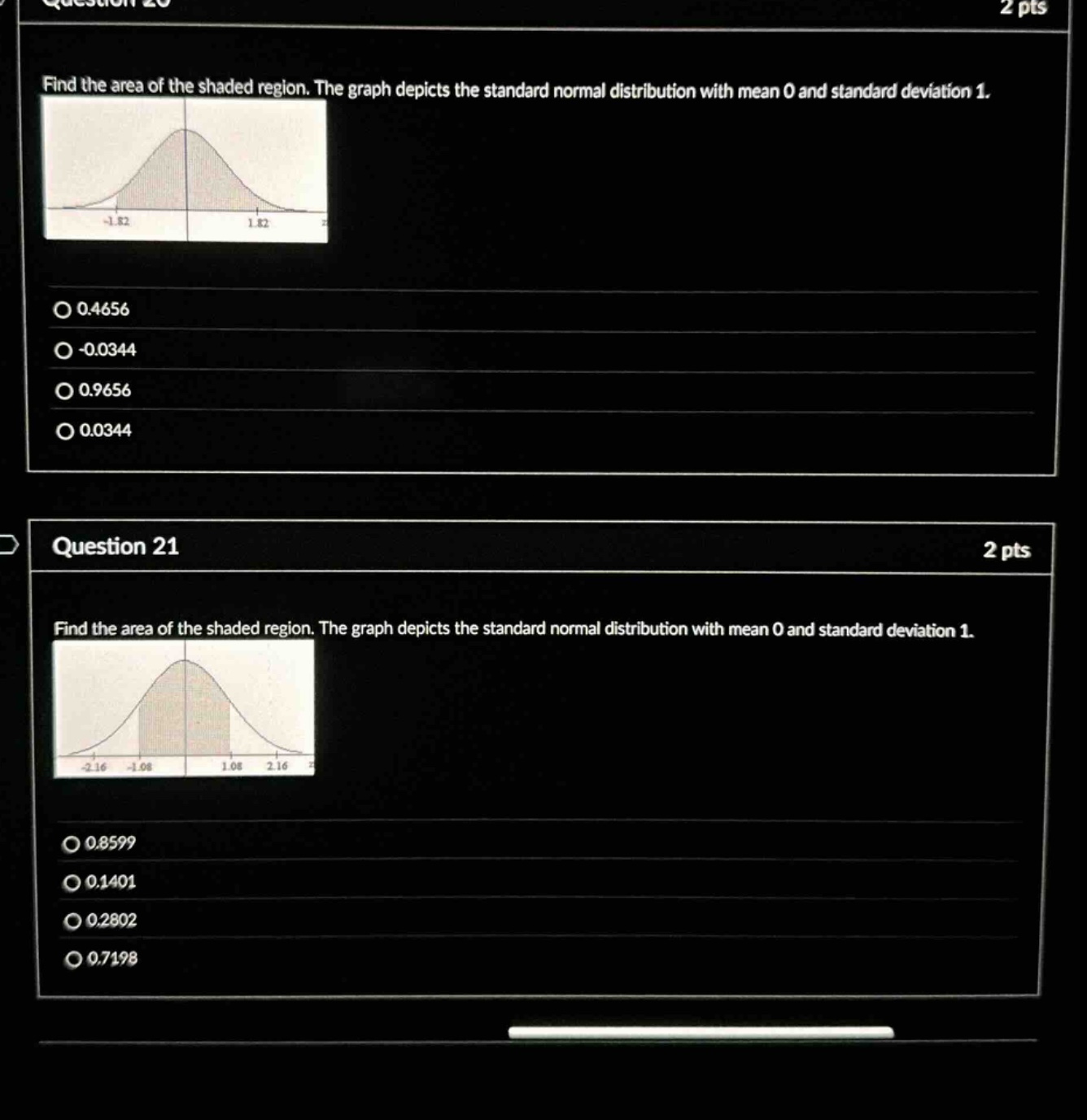
question 20\n2 pts\nfind the area of the shaded region. the graph depicts the standard normal distribution with mean 0 and standard deviation 1.\n-1.82 1.82\n0.4656\n-0.0344\n0.9656\n0.0344\nquestion 21\n2 pts\nfind the area of the shaded region. the graph depicts the standard normal distribution with mean 0 and standard deviation 1.\n-2.16 -1.08 1.08 2.16\n0.8599\n0.1401\n0.2802\n0.7198
Answer
Answer:
Question 20: C. 0.9656 Question 21: A. 0.8599
Explanation:
Question 20
Step1: Use z - table property
The standard normal distribution is symmetric about (z = 0). We want to find (P(- 1.82<Z<1.82)). We know that (P(Z < 1.82)) from the standard - normal table is (0.9656) and (P(Z<-1.82)=1 - P(Z < 1.82)). Then (P(-1.82 < Z < 1.82)=P(Z < 1.82)-P(Z<-1.82)). Since (P(Z<-1.82)=1 - P(Z < 1.82)), we have (P(-1.82 < Z < 1.82)=2P(Z < 1.82)-1). Looking up (P(Z < 1.82)) in the z - table, we get (P(Z < 1.82)=0.9656).
Question 21
Step1: Use z - table property
We want to find (P(-1.08 < Z < 1.08)). Using the property of the standard normal distribution and the z - table, we know that (P(Z < 1.08)) from the z - table is (0.8599) and (P(Z<-1.08)=1 - P(Z < 1.08)). Then (P(-1.08 < Z < 1.08)=P(Z < 1.08)-P(Z<-1.08)=2P(Z < 1.08)-1). Looking up (P(Z < 1.08)) in the z - table gives (P(Z < 1.08)=0.8599).