question\nalang has a bag that contains pineapple chews, strawberry chews, and lime chews. he performs an…
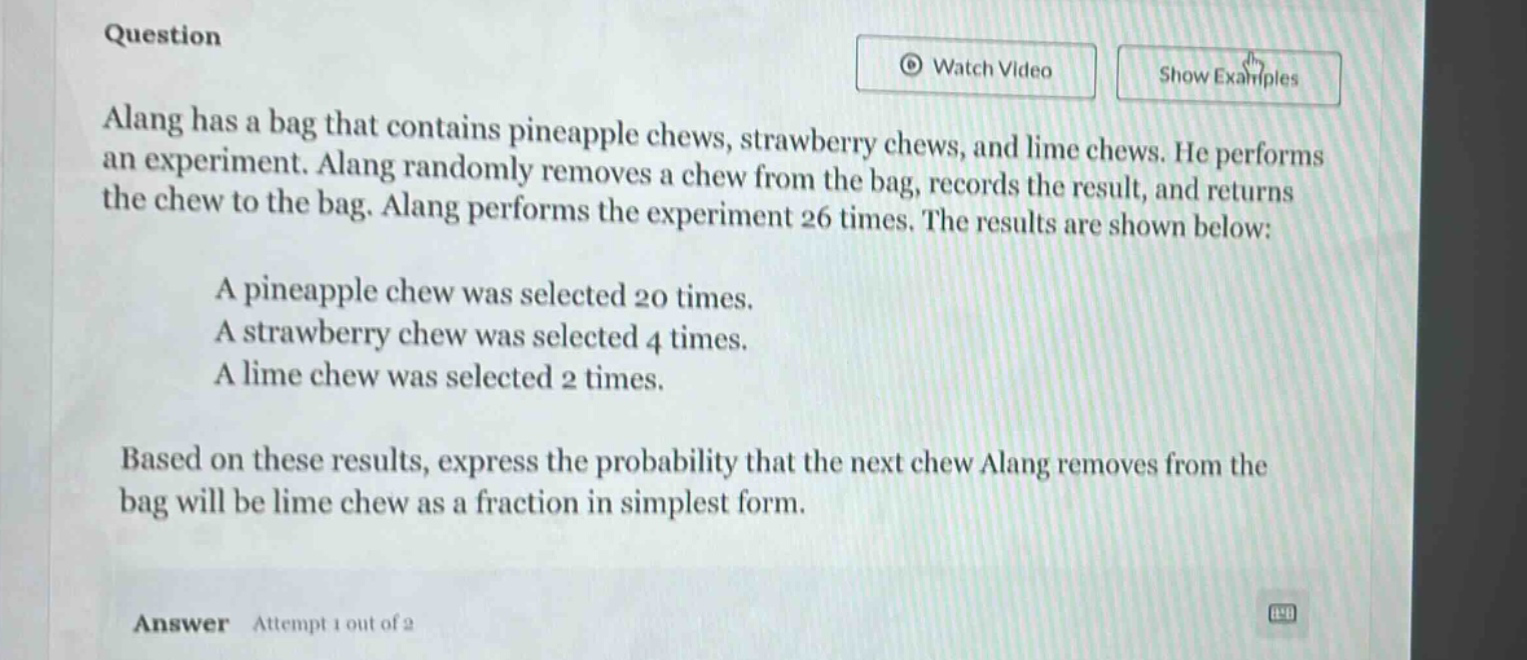
question\nalang has a bag that contains pineapple chews, strawberry chews, and lime chews. he performs an experiment. alang randomly removes a chew from the bag, records the result, and returns the chew to the bag. alang performs the experiment 26 times. the results are shown below:\na pineapple chew was selected 20 times.\na strawberry chew was selected 4 times.\na lime chew was selected 2 times.\nbased on these results, express the probability that the next chew alang removes from the bag will be lime chew as a fraction in simplest form.\nanswer attempt 1 out of 2
Answer
Explanation:
Step1: Recall probability formula
Probability = $\frac{\text{Number of favorable outcomes}}{\text{Total number of outcomes}}$
Step2: Identify values
The number of times a lime - chew was selected (favorable outcomes) is 2. The total number of experiments (total number of outcomes) is 26.
Step3: Calculate probability
The probability $P$ of selecting a lime - chew is $P=\frac{2}{26}$
Step4: Simplify fraction
$\frac{2\div2}{26\div2}=\frac{1}{13}$
Answer:
$\frac{1}{13}$