question 1 :=\nwhich of the following describes nuclear fusion?\nthe joining together of two or more smaller…
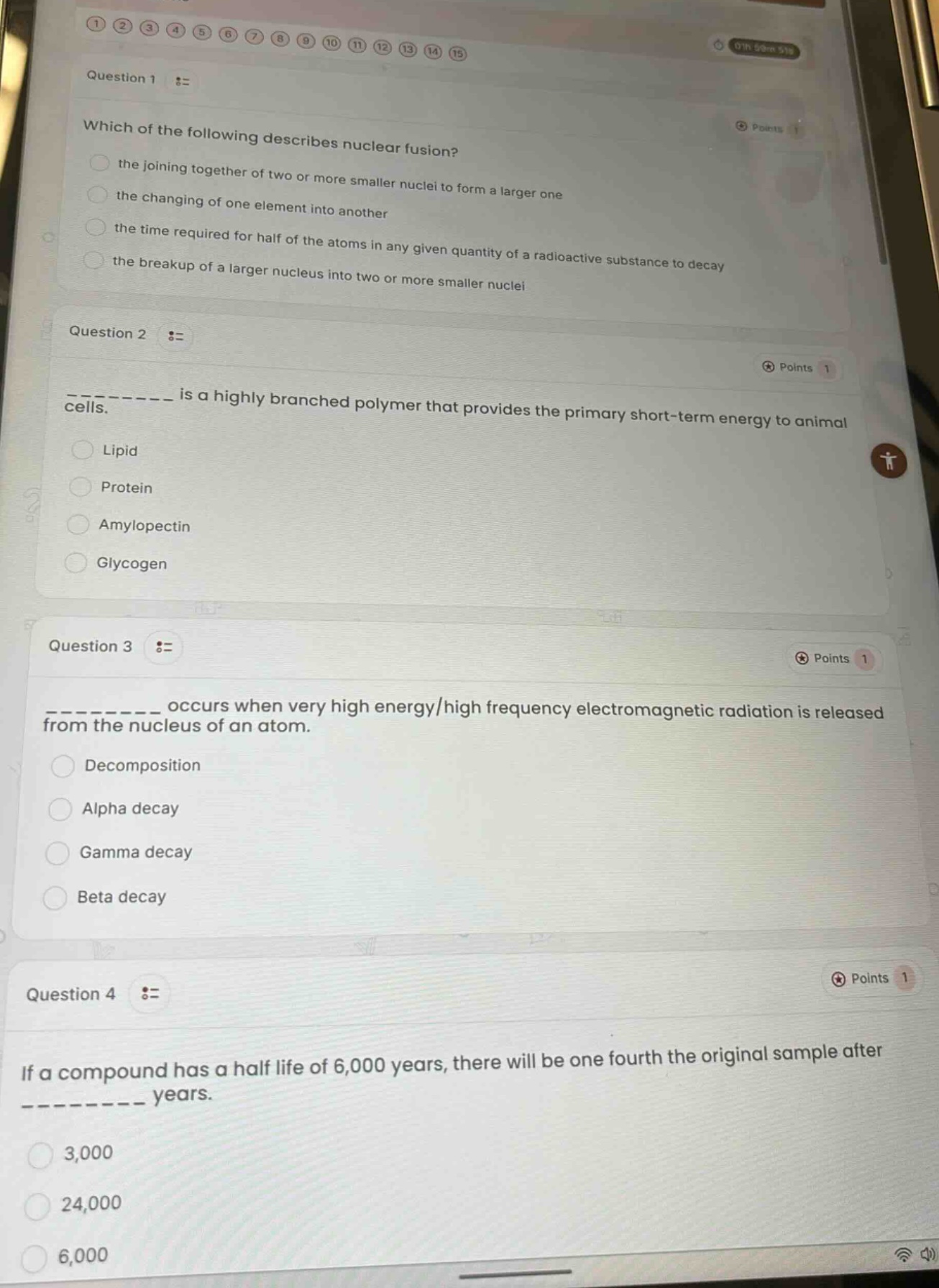
question 1 :=\nwhich of the following describes nuclear fusion?\nthe joining together of two or more smaller nuclei to form a larger one\nthe changing of one element into another\nthe time required for half of the atoms in any given quantity of a radioactive substance to decay\nthe breakup of a larger nucleus into two or more smaller nuclei\n\nquestion 2 :=\n__________ is a highly branched polymer that provides the primary short - term energy to animal cells.\nlipid\nprotein\namylopectin\nglycogen\n\nquestion 3 :=\n__________ occurs when very high energy/high frequency electromagnetic radiation is released from the nucleus of an atom.\ndecomposition\nalpha decay\ngamma decay\nbeta decay\n\nquestion 4 :=\nif a compound has a half life of 6,000 years, there will be one fourth the original sample after __________ years.\n3,000\n24,000\n6,000
Answer
Answer:
Question 1: the joining together of two or more smaller nuclei to form a larger one Question 2: Glycogen Question 3: Gamma decay Question 4: 12,000
Explanation:
Step1: Define nuclear fusion
Nuclear fusion is the combination of smaller nuclei to form a larger one.
Step2: Recall energy - storage polymers
Glycogen is a highly - branched polymer for short - term energy in animal cells.
Step3: Identify radiation type
Gamma decay releases high - energy/high - frequency electromagnetic radiation from the nucleus.
Step4: Calculate half - life time
If the half - life is 6000 years, to get to one - fourth (after 2 half - lives) of the original sample, $t = 2\times6000=12000$ years.