question 5: people without disabilities might use the following “aids” for communicating: a. a computer. b…
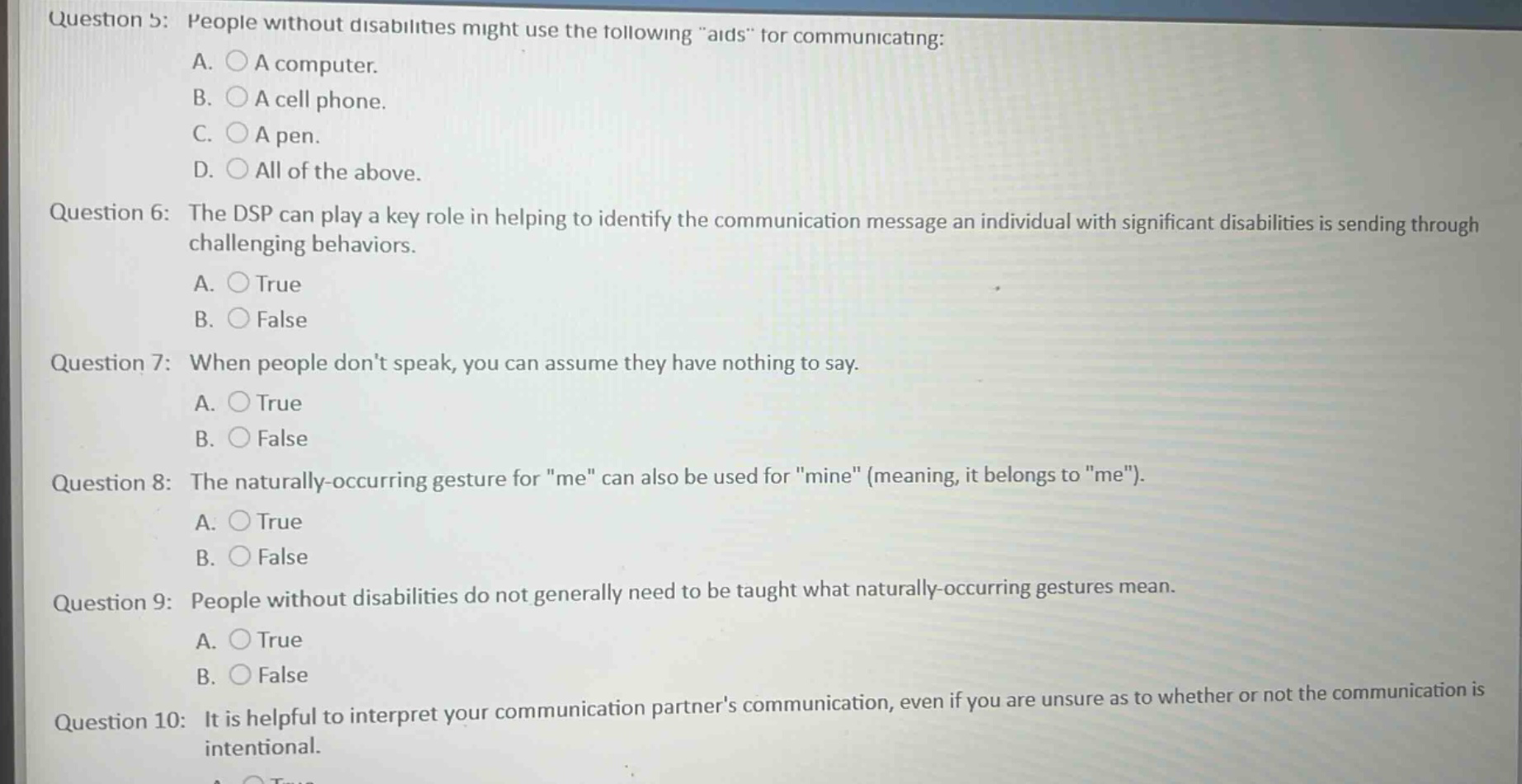
question 5: people without disabilities might use the following “aids” for communicating: a. a computer. b. a cell phone. c. a pen. d. all of the above. question 6: the dsp can play a key role in helping to identify the communication message an individual with significant disabilities is sending through challenging behaviors. a. true b. false question 7: when people don’t speak, you can assume they have nothing to say. a. true b. false question 8: the naturally - occurring gesture for “me” can also be used for “mine” (meaning, it belongs to “me”). a. true b. false question 9: people without disabilities do not generally need to be taught what naturally - occurring gestures mean. a. true b. false question 10: it is helpful to interpret your communication partner’s communication, even if you are unsure as to whether or not the communication is intentional.
Answer
Brief Explanations:
- Question 5: Computers, cell - phones, and pens can all be used for communication by non - disabled people.
- Question 6: DSP (Direct Support Professional) can analyze challenging behaviors to identify communication messages of disabled individuals.
- Question 7: People may have things to say but not use verbal speech, e.g., through non - verbal means.
- Question 8: In some communication systems, the gesture for "me" can imply "mine".
- Question 9: Non - disabled people often learn the meaning of natural gestures through social interaction without formal teaching.
- Question 10: Interpreting communication, even if unsure of intent, can help in understanding the partner.
Answer:
Question 5: D. All of the above Question 6: A. True Question 7: B. False Question 8: A. True Question 9: A. True Question 10: A. True