question 4 (1 point)\nscientists hypothesize that 66 million years ago an enormous asteroid hit earth…
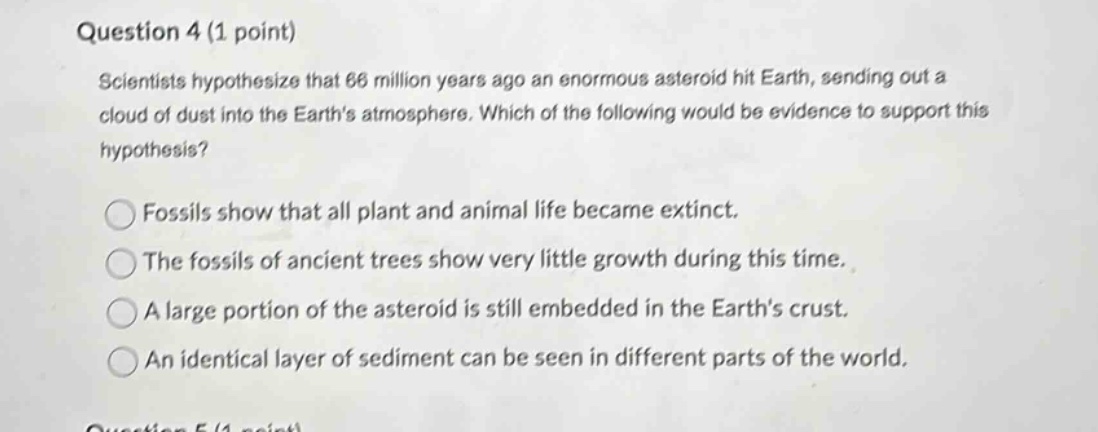
question 4 (1 point)\nscientists hypothesize that 66 million years ago an enormous asteroid hit earth, sending out a cloud of dust into the earths atmosphere. which of the following would be evidence to support this hypothesis?\nfossils show that all plant and animal life became extinct.\nthe fossils of ancient trees show very little growth during this time.\na large portion of the asteroid is still embedded in the earths crust.\nan identical layer of sediment can be seen in different parts of the world.
Answer
Brief Explanations:
If an asteroid hit Earth and sent out a dust - cloud, it would have affected the global environment. Identical sediment layers in different parts of the world could be from the dust and debris spread globally by the impact. Fossils showing all life extinct is too extreme as not all life went extinct. Ancient tree fossils with little growth could be due to other factors. A large portion of the asteroid still embedded doesn't necessarily prove the dust - cloud hypothesis.
Answer:
An identical layer of sediment can be seen in different parts of the world.