question\nthe table shows the total number of posts made by the average registered user of a new social…
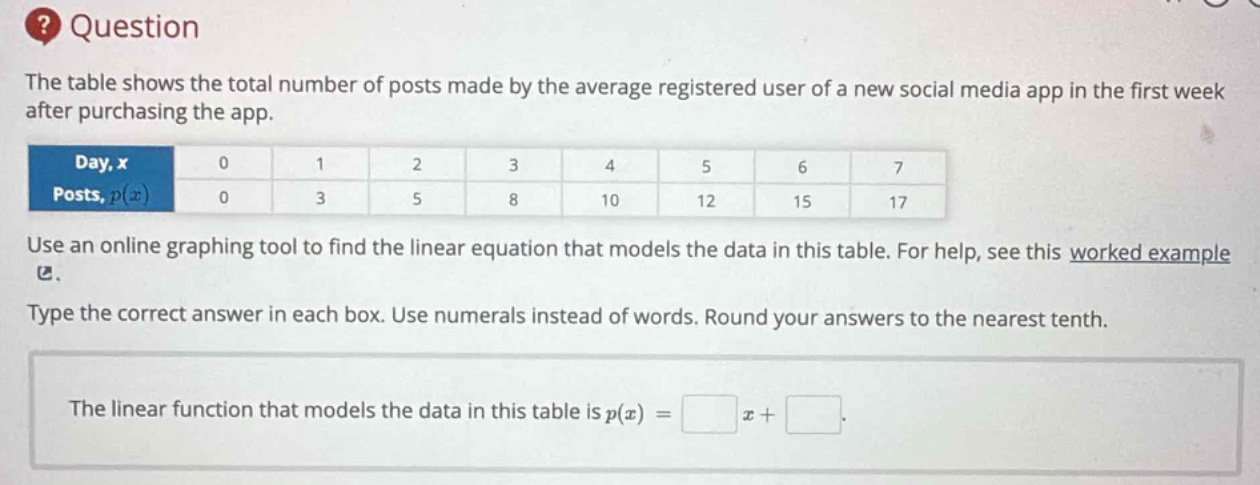
question\nthe table shows the total number of posts made by the average registered user of a new social media app in the first week after purchasing the app.\n| day, x | 0 | 1 | 2 | 3 | 4 | 5 | 6 | 7 |\n| posts, p(x) | 0 | 3 | 5 | 8 | 10 | 12 | 15 | 17 |\nuse an online graphing tool to find the linear equation that models the data in this table. for help, see this worked example.\ntype the correct answer in each box. use numerals instead of words. round your answers to the nearest tenth.\nthe linear function that models the data in this table is p(x)= x +.
Answer
Explanation:
Step1: Recall linear - equation form
The general form of a linear equation is $y = mx + b$, where $m$ is the slope and $b$ is the y - intercept. In our case, $y=p(x)$ and $x$ is the day.
Step2: Calculate the slope $m$
The formula for the slope $m=\frac{\sum_{i = 1}^{n}(x_{i}-\bar{x})(y_{i}-\bar{y})}{\sum_{i = 1}^{n}(x_{i}-\bar{x})^{2}}$. First, find the means of $x$ and $y$ values. The $x$ - values are $x={0,1,2,3,4,5,6,7}$, so $\bar{x}=\frac{0 + 1+2+3+4+5+6+7}{8}=\frac{28}{8}=3.5$. The $y$ - values are $y = {0,3,5,8,10,12,15,17}$, so $\bar{y}=\frac{0 + 3+5+8+10+12+15+17}{8}=\frac{70}{8}=8.75$. $\sum_{i = 1}^{8}(x_{i}-\bar{x})(y_{i}-\bar{y})=(0 - 3.5)(0 - 8.75)+(1 - 3.5)(3 - 8.75)+(2 - 3.5)(5 - 8.75)+(3 - 3.5)(8 - 8.75)+(4 - 3.5)(10 - 8.75)+(5 - 3.5)(12 - 8.75)+(6 - 3.5)(15 - 8.75)+(7 - 3.5)(17 - 8.75)$ $=(-3.5)(-8.75)+(-2.5)(-5.75)+(-1.5)(-3.75)+(-0.5)(-0.75)+(0.5)(1.25)+(1.5)(3.25)+(2.5)(6.25)+(3.5)(8.25)$ $=30.625 + 14.375+5.625 + 0.375+0.625+4.875+15.625+28.875$ $=101$. $\sum_{i = 1}^{8}(x_{i}-\bar{x})^{2}=(0 - 3.5)^{2}+(1 - 3.5)^{2}+(2 - 3.5)^{2}+(3 - 3.5)^{2}+(4 - 3.5)^{2}+(5 - 3.5)^{2}+(6 - 3.5)^{2}+(7 - 3.5)^{2}$ $=12.25+6.25 + 2.25+0.25+0.25+2.25+6.25+12.25$ $=42$. $m=\frac{101}{42}\approx2.4$.
Step3: Calculate the y - intercept $b$
We know that $y = mx + b$. Substitute one of the points, say $(0,0)$ (we can also use other points) into the equation $y=mx + b$. When $x = 0$ and $y = 0$, and $m\approx2.4$, we get $0=2.4\times0 + b$, so $b\approx - 0.5$.
Answer:
$p(x)=2.4x - 0.5$