question\nximena has a bag that contains strawberry chews, apple chews, and peach chews. she performs an…
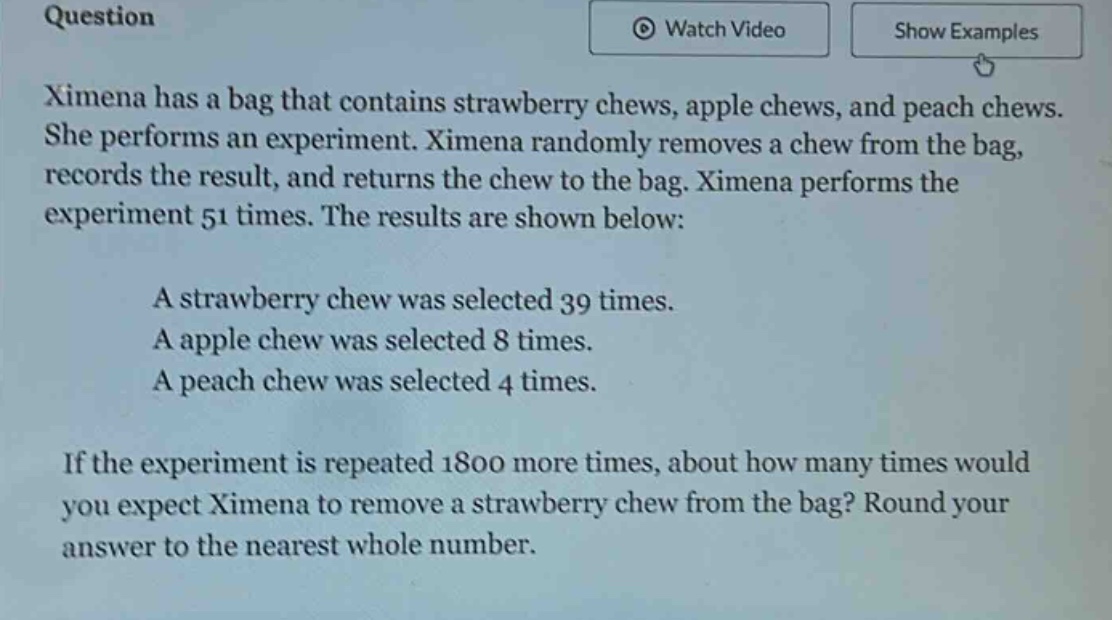
question\nximena has a bag that contains strawberry chews, apple chews, and peach chews. she performs an experiment. ximena randomly removes a chew from the bag, records the result, and returns the chew to the bag. ximena performs the experiment 51 times. the results are shown below:\na strawberry chew was selected 39 times.\na apple chew was selected 8 times.\na peach chew was selected 4 times.\nif the experiment is repeated 1800 more times, about how many times would you expect ximena to remove a strawberry chew from the bag? round your answer to the nearest whole number.
Answer
Answer:
1376
Explanation:
Step1: Calculate experimental probability
The experimental - probability of selecting a strawberry chew is the number of times a strawberry chew was selected divided by the total number of trials in the first experiment. The total number of trials in the first experiment is $n = 39+8 + 4=51$ times, and the number of times a strawberry chew was selected is $m = 39$ times. So the experimental probability $P$ of selecting a strawberry chew is $P=\frac{39}{51}=\frac{13}{17}$.
Step2: Predict the number of times
If the experiment is repeated $N = 1800$ more times, the expected number of times a strawberry chew is selected $E$ is given by the product of the experimental probability and the number of new trials. So $E=\frac{13}{17}\times1800=\frac{23400}{17}\approx1376.47$. Rounding to the nearest whole - number, we get $E = 1376$.