quinn mailed four postcards that each cost $0.25, five letters that each cost $0.44, two large envelopes…
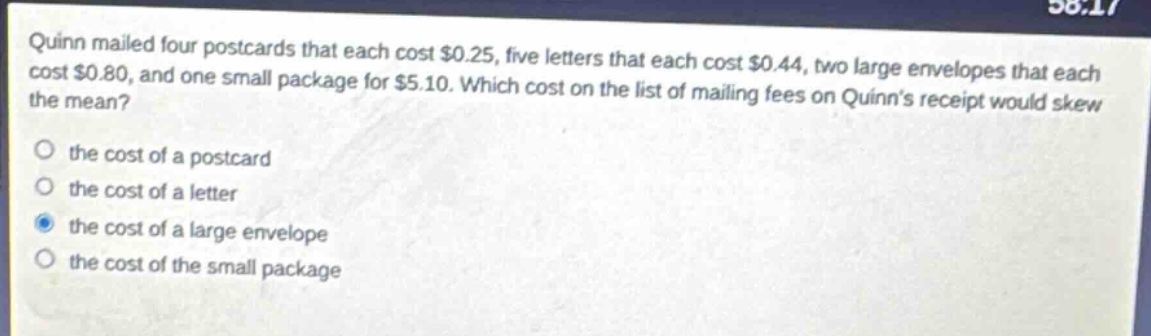
quinn mailed four postcards that each cost $0.25, five letters that each cost $0.44, two large envelopes that each cost $0.80, and one small package for $5.10. which cost on the list of mailing fees on quinns receipt would skew the mean?\no the cost of a postcard\no the cost of a letter\no the cost of a large envelope\no the cost of the small package
Answer
Explanation:
Step1: Understand skewness concept
Skewness in data is caused by outliers. Outliers are values far from other data - points.
Step2: Analyze each cost
Cost of post - card: $0.25$, cost of letter: $0.44$, cost of large envelope: $0.80$, cost of small package: $5.10$.
Step3: Identify the outlier
The cost of the small package ($5.10$) is much larger than the other costs ($0.25$, $0.44$, $0.80$). An outlier will skew the mean.
Answer:
the cost of the small package