quinta is rolling a dice and keeping track of the number she gets on each roll. the table below summarizes…
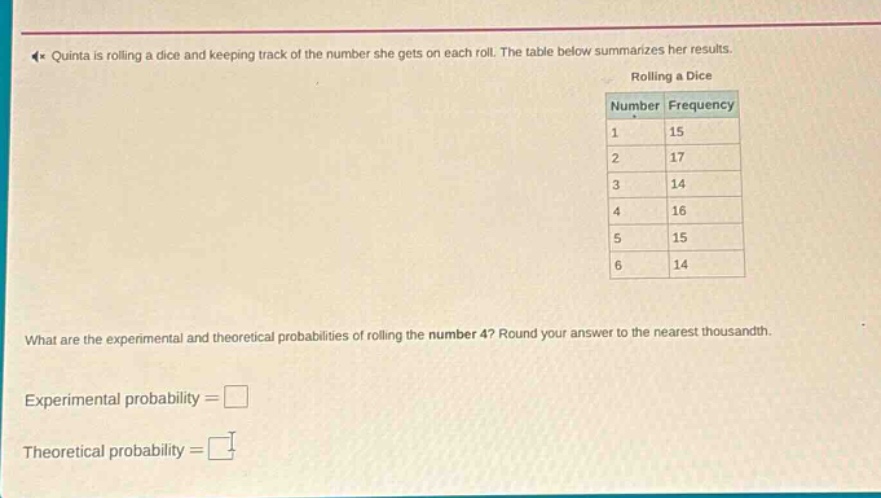
quinta is rolling a dice and keeping track of the number she gets on each roll. the table below summarizes her results. rolling a dice number frequency 1 15 2 17 3 14 4 16 5 15 6 14 what are the experimental and theoretical probabilities of rolling the number 4? round your answer to the nearest thousandth. experimental probability = theoretical probability =
Answer
Explanation:
Step1: Calculate total number of rolls
Add up all frequencies. $15 + 17+14 + 16+15+14=91$.
Step2: Calculate experimental probability
The frequency of rolling a 4 is 16. Experimental probability $P_{exp}=\frac{\text{Frequency of 4}}{\text{Total rolls}}=\frac{16}{91}\approx 0.176$.
Step3: Calculate theoretical probability
A fair - die has 6 sides. Theoretical probability $P_{theo}=\frac{1}{6}\approx 0.167$.
Answer:
Experimental probability = 0.176 Theoretical probability = 0.167