the radius and circumference of several objects were measured.\nradius and circumference of objects\nradius…
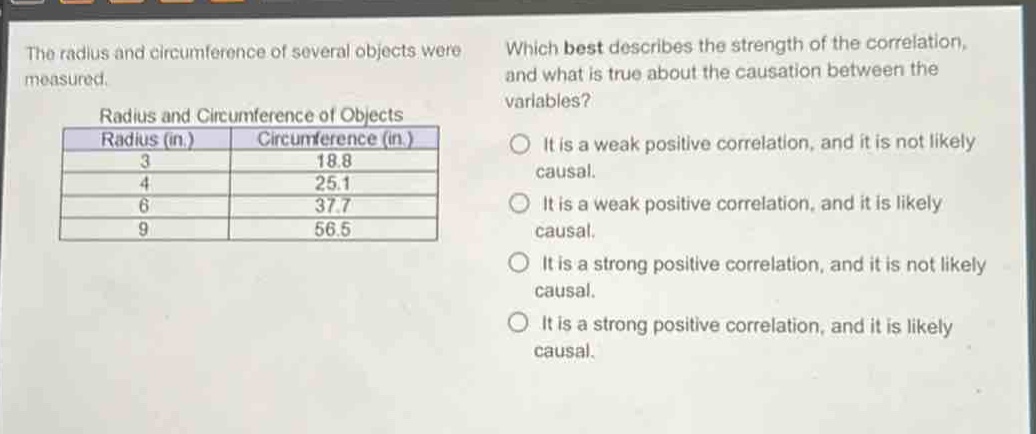
the radius and circumference of several objects were measured.\nradius and circumference of objects\nradius (in.) circumference (in.)\n3 18.8\n4 25.1\n6 37.7\n9 56.5\nwhich best describes the strength of the correlation, and what is true about the causation between the variables?\nit is a weak positive correlation, and it is not likely causal.\nit is a weak positive correlation, and it is likely causal.\nit is a strong positive correlation, and it is not likely causal.\nit is a strong positive correlation, and it is likely causal.
Answer
Explanation:
Step1: Recall the formula for circumference
The formula for the circumference of a circle is $C = 2\pi r$, where $C$ is the circumference and $r$ is the radius.
Step2: Analyze the relationship
As the radius $r$ increases, the circumference $C$ increases proportionally since $C$ is directly proportional to $r$ with a constant of proportionality $2\pi$. A direct - proportional relationship implies a strong positive correlation. Also, the radius of a circle causes its circumference (changing the radius will change the circumference), so it is a causal relationship.
Answer:
It is a strong positive correlation, and it is likely causal.