the radius and circumference of several objects were measured.\nradius and circumference of objects\n|radius…
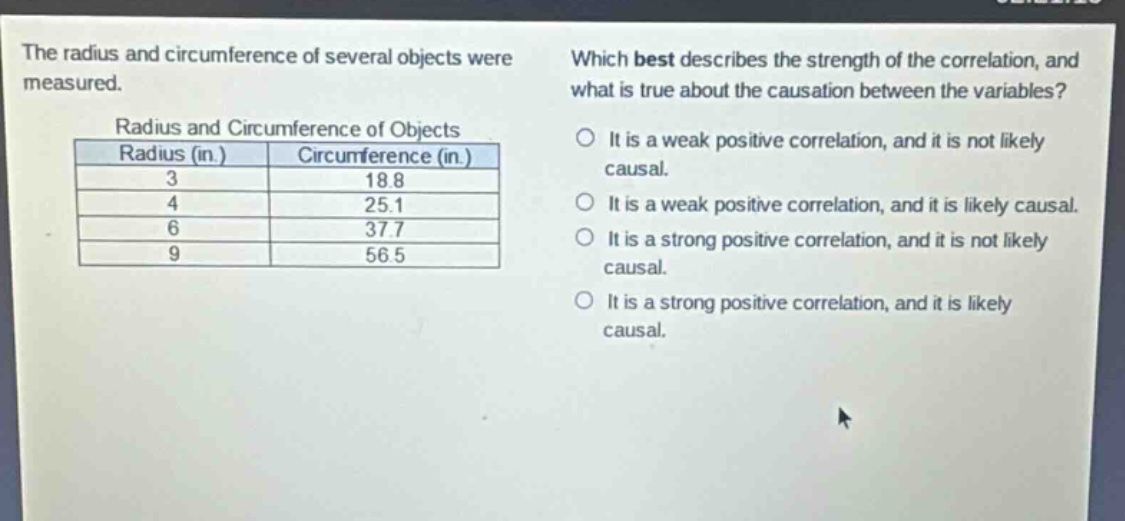
the radius and circumference of several objects were measured.\nradius and circumference of objects\n|radius (in.)|circumference (in.)|\n|----|----|\n|3|18.8|\n|4|25.1|\n|6|37.7|\n|9|56.5|\nwhich best describes the strength of the correlation, and what is true about the causation between the variables?\no it is a weak positive correlation, and it is not likely causal.\no it is a weak positive correlation, and it is likely causal.\no it is a strong positive correlation, and it is not likely causal.\no it is a strong positive correlation, and it is likely causal.
Answer
Answer:
It is a strong positive correlation, and it is likely causal.
Explanation:
Step1: Recall the formula for circumference
The formula for the circumference of a circle is $C = 2\pi r$, where $C$ is the circumference and $r$ is the radius.
Step2: Analyze the relationship
As the radius $r$ increases, the circumference $C$ increases proportionally. Since the relationship is based on a well - defined mathematical formula, it is a causal relationship. Also, the relationship is linear and direct, which indicates a strong positive correlation.