3. the radius of the entire dartboard is 40 cm, while the radius of the red circle is 20 cm. if a dart is…
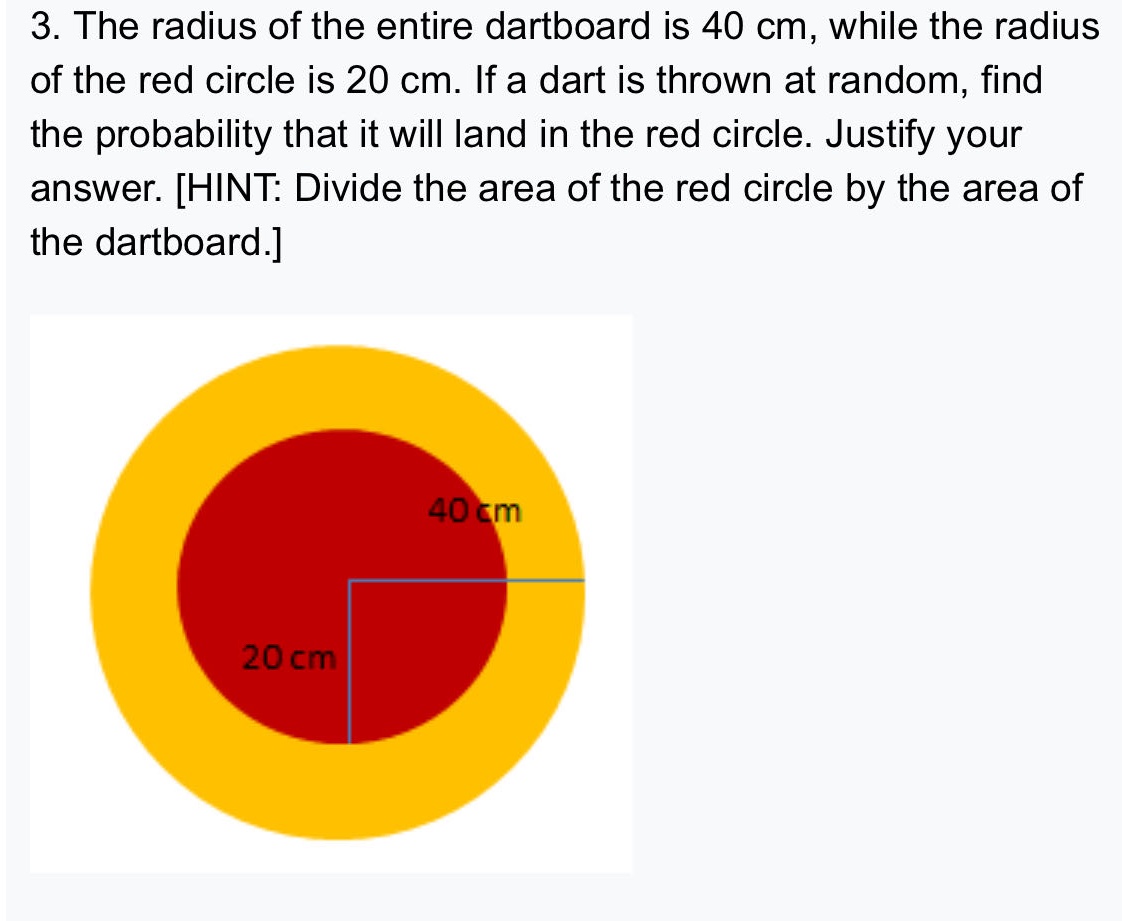
3. the radius of the entire dartboard is 40 cm, while the radius of the red circle is 20 cm. if a dart is thrown at random, find the probability that it will land in the red circle. justify your answer. hint: divide the area of the red circle by the area of the dartboard.
Answer
Explanation:
Step1: Find area of red - circle
The formula for the area of a circle is $A = \pi r^{2}$. For the red - circle with radius $r_1=20$ cm, its area $A_1=\pi r_1^{2}=\pi\times(20)^{2}=400\pi$ $cm^{2}$.
Step2: Find area of dart - board
For the dart - board with radius $r_2 = 40$ cm, its area $A_2=\pi r_2^{2}=\pi\times(40)^{2}=1600\pi$ $cm^{2}$.
Step3: Calculate probability
The probability $P$ that the dart lands in the red circle is given by the ratio of the area of the red circle to the area of the dart - board. So $P=\frac{A_1}{A_2}=\frac{400\pi}{1600\pi}=\frac{1}{4}$.
Answer:
$\frac{1}{4}$