a random number generator is used to create a list of 150 single - digit numbers. of those 150 numbers, 72…
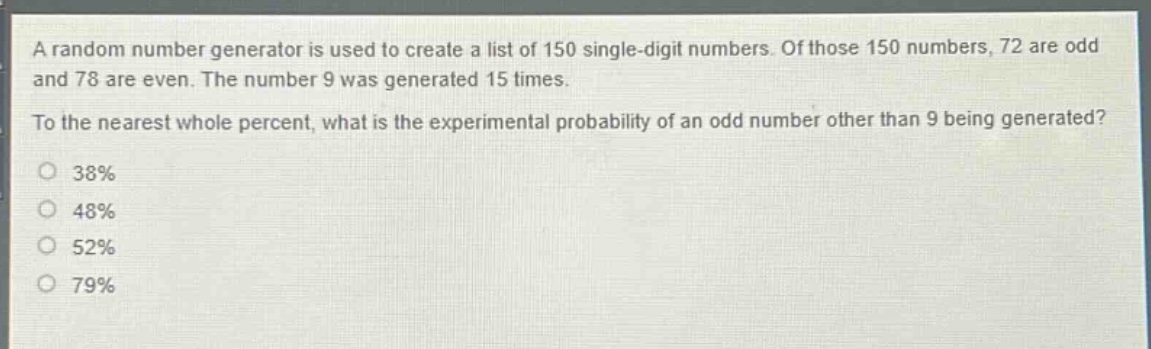
a random number generator is used to create a list of 150 single - digit numbers. of those 150 numbers, 72 are odd and 78 are even. the number 9 was generated 15 times. to the nearest whole percent, what is the experimental probability of an odd number other than 9 being generated? 38% 48% 52% 79%
Answer
Explanation:
Step1: Find odd numbers other than 9
The number of odd - numbered results is 72, and the number of 9s is 15. So the number of odd numbers other than 9 is $72 - 15=57$.
Step2: Calculate experimental probability
The experimental probability $P$ of an event is given by the formula $P=\frac{\text{number of favorable outcomes}}{\text{total number of outcomes}}$. Here, the total number of outcomes is 150 and the number of favorable outcomes (odd numbers other than 9) is 57. So $P=\frac{57}{150}=0.38$.
Step3: Convert to percentage
To convert the decimal to a percentage, we multiply by 100. So $0.38\times100 = 38%$.
Answer:
38%