read the following description of a data set.\na french car company wants to cut costs by using cheaper low…
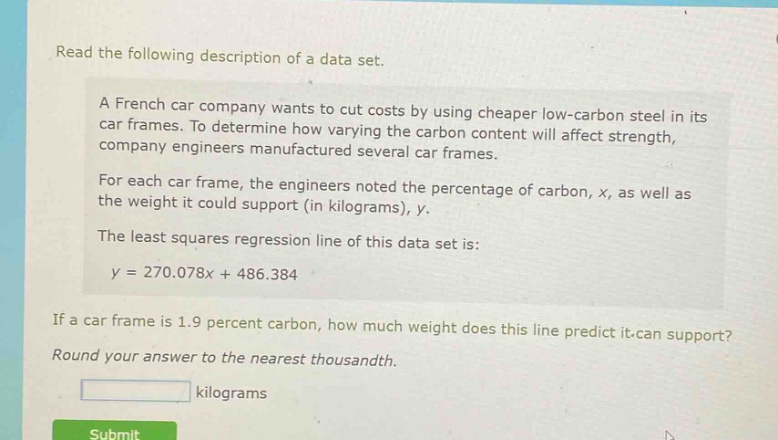
read the following description of a data set.\na french car company wants to cut costs by using cheaper low - carbon steel in its car frames. to determine how varying the carbon content will affect strength, company engineers manufactured several car frames.\nfor each car frame, the engineers noted the percentage of carbon, x, as well as the weight it could support (in kilograms), y.\nthe least squares regression line of this data set is:\ny = 270.078x + 486.384\nif a car frame is 1.9 percent carbon, how much weight does this line predict it can support?\nround your answer to the nearest thousandth.\nkilograms
Answer
Explanation:
Step1: Identify the values
We are given $x = 1.9$ and the regression - line equation $y=270.078x + 486.384$.
Step2: Substitute the value of x
Substitute $x = 1.9$ into the equation $y=270.078x + 486.384$. $y=270.078\times1.9+486.384$ First, calculate $270.078\times1.9$: $270.078\times1.9 = 513.1482$ Then, add $486.384$: $y=513.1482 + 486.384=999.5322$
Step3: Round the result
Round $999.5322$ to the nearest thousandth. $y\approx999.532$
Answer:
$999.532$