read the story. quartz crusade is abduls favorite video game. each level in the game is a new cave full of…
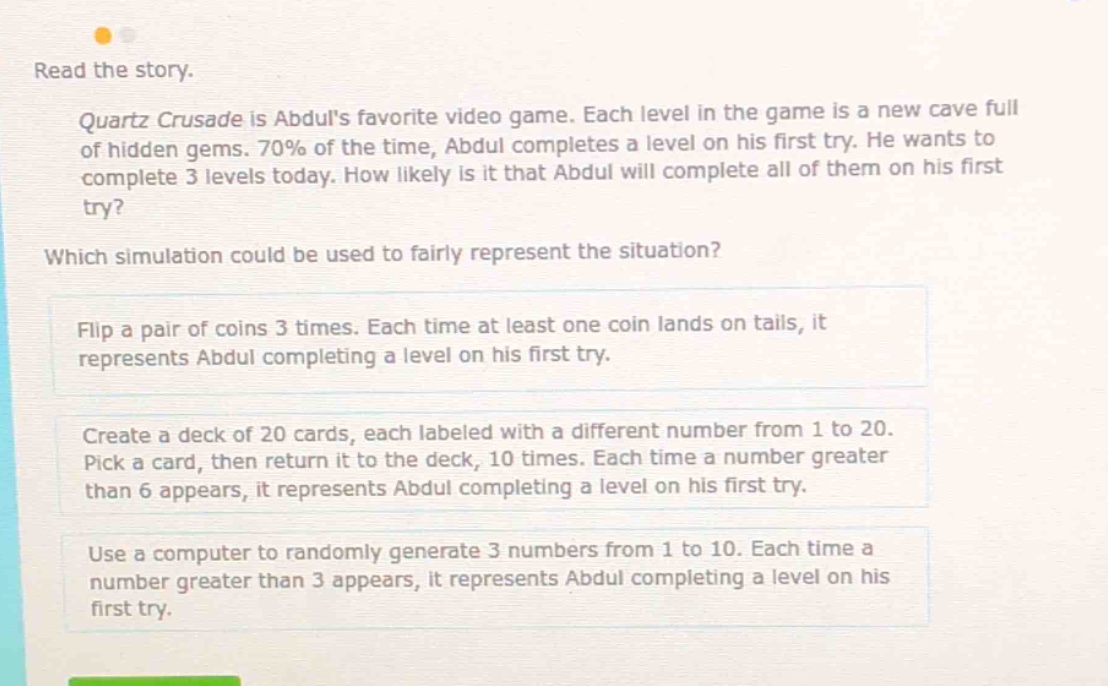
read the story. quartz crusade is abduls favorite video game. each level in the game is a new cave full of hidden gems. 70% of the time, abdul completes a level on his first try. he wants to complete 3 levels today. how likely is it that abdul will complete all of them on his first try? which simulation could be used to fairly represent the situation? flip a pair of coins 3 times. each time at least one coin lands on tails, it represents abdul completing a level on his first try. create a deck of 20 cards, each labeled with a different number from 1 to 20. pick a card, then return it to the deck, 10 times. each time a number greater than 6 appears, it represents abdul completing a level on his first try. use a computer to randomly generate 3 numbers from 1 to 10. each time a number greater than 3 appears, it represents abdul completing a level on his first try.
Answer
Explanation:
Step1: Calculate probability for each simulation
- For coin - flip: Probability of at least one tail in a pair - coin flip is $P(\text{at least one tail}) = 1 - P(\text{both heads})=1-\frac{1}{2}\times\frac{1}{2}=\frac{3}{4}= 0.75\neq0.7$.
- For card - pick: Probability of picking a number greater than 6 out of 20 numbers is $P(\text{number}>6)=\frac{20 - 6}{20}=\frac{14}{20}=0.7$.
- For computer - generated numbers: Probability of generating a number greater than 3 out of 10 numbers is $P(\text{number}>3)=\frac{10 - 3}{10}=0.7$. But we only need to generate 3 numbers, not 10.
Step2: Determine the correct simulation
The situation requires a simulation with a probability of 0.7 for each independent trial and we need 3 independent trials. Picking a card from a deck of 20 cards (with replacement) 3 times, where a number greater than 6 represents success, has the correct probability and number of trials.