a real estate agent conducted an experiment to test the effect of selling a staged home vs. selling an empty…
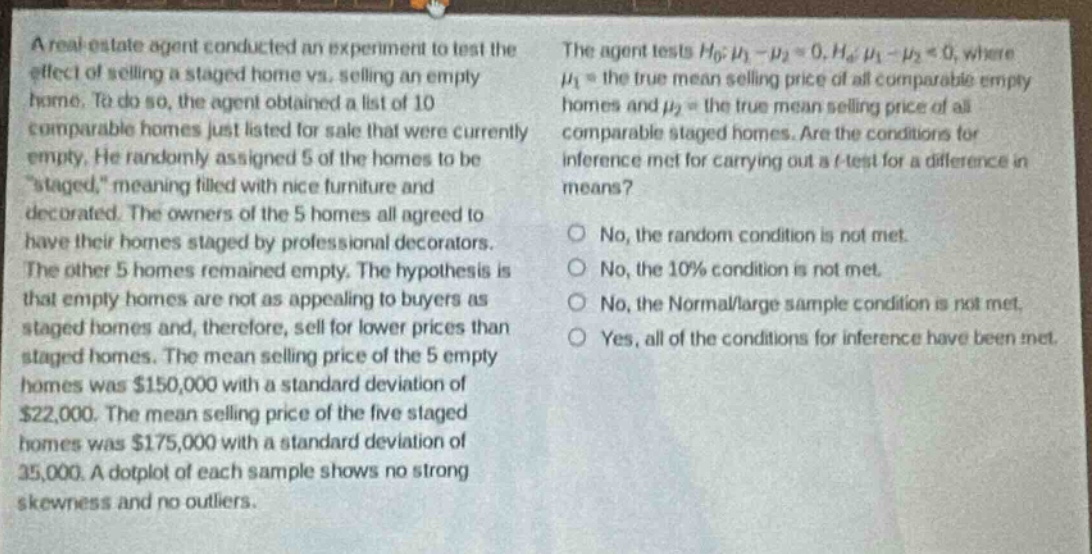
a real estate agent conducted an experiment to test the effect of selling a staged home vs. selling an empty home. to do so, the agent obtained a list of 10 comparable homes just listed for sale that were currently empty. he randomly assigned 5 of the homes to be “staged,” meaning filled with nice furniture and decorated. the owners of the 5 homes all agreed to have their homes staged by professional decorators. the other 5 homes remained empty. the hypothesis is that empty homes are not as appealing to buyers as staged homes and, therefore, sell for lower prices than staged homes. the mean selling price of the 5 empty homes was $150,000 with a standard deviation of $22,000. the mean selling price of the five staged homes was $175,000 with a standard deviation of $25,000. a dot - plot of each sample shows no strong skewness and no outliers. the agent tests $h_0:mu_1-mu_2 = 0, h_a:mu_1-mu_2<0$, where $mu_1$ = the true mean selling price of all comparable empty homes and $mu_2$ = the true mean selling price of all comparable staged homes. are the conditions for inference met for carrying out a t - test for a difference in means? no, the random condition is not met. no, the 10% condition is not met. no, the normal/large sample condition is not met. yes, all of the conditions for inference have been met.
Answer
Brief Explanations:
- Random Condition: The agent randomly assigned 5 out of 10 homes to be staged, so the random - assignment condition for a two - sample t - test is met.
- 10% Condition: Since the sample size (n_1 = n_2=5) is likely to be less than 10% of all comparable empty and staged homes respectively (as there are many such homes in the real - estate market), the 10% condition is met.
- Normal/Large Sample Condition: The dot - plots of each sample show no strong skewness and no outliers. Also, although the sample sizes (n_1 = n_2 = 5) are small, the absence of skewness and outliers suggests approximate normality. So the normal/large sample condition is met.
Answer:
Yes, all of the conditions for inference have been met.