a recent study on the relationship between childrens weight and their achievement test scores determined the…
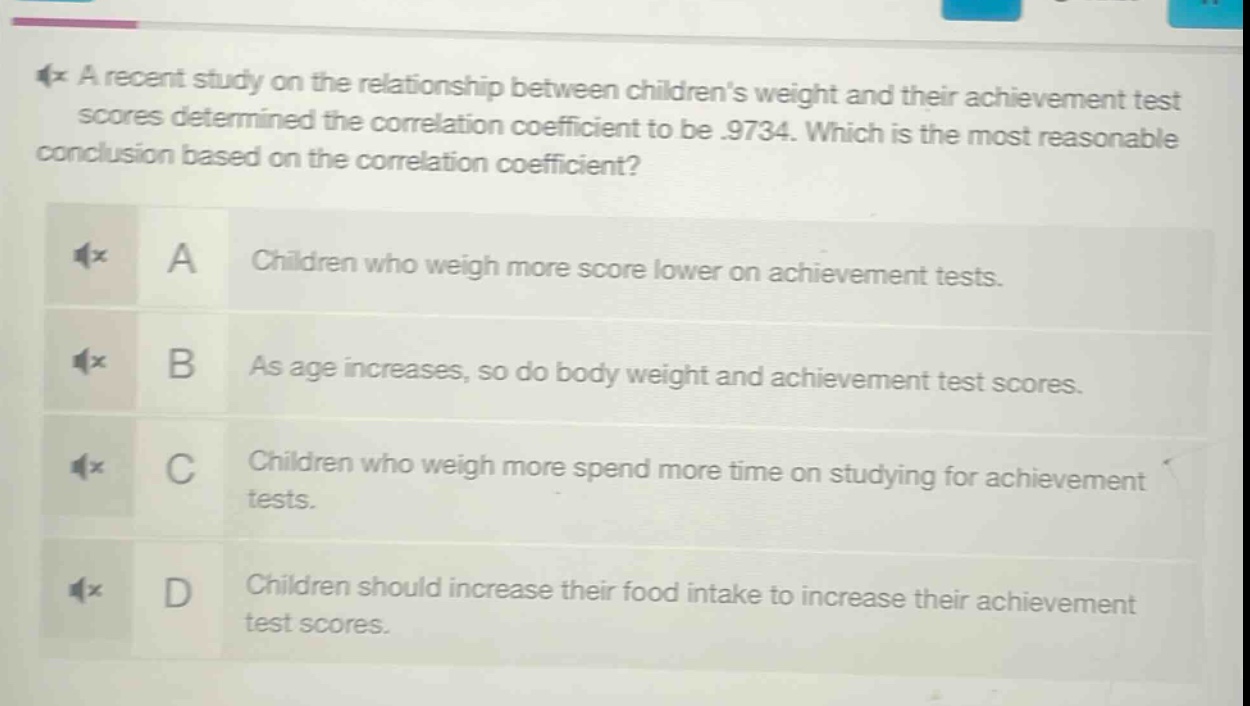
a recent study on the relationship between childrens weight and their achievement test scores determined the correlation coefficient to be .9734. which is the most reasonable conclusion based on the correlation coefficient? a children who weigh more score lower on achievement tests. b as age increases, so do body weight and achievement test scores. c children who weigh more spend more time on studying for achievement tests. d children should increase their food intake to increase their achievement test scores.
Answer
Brief Explanations:
A correlation coefficient close to 1 indicates a strong positive linear - relationship. Here, a correlation coefficient of 0.9734 between children's weight and achievement test scores means as weight increases, achievement test scores tend to increase.
Answer:
None of the given options are correct. A more reasonable conclusion would be that there is a strong positive relationship between children's weight and their achievement test scores, meaning children who weigh more tend to score higher on achievement tests (but this is just a correlation and not necessarily a causal relationship). If we had to choose from the given options, none accurately represent the meaning of the correlation coefficient value.