recovering from surgery: a new postsurgical treatment was compared with a standard treatment. seven subjects…
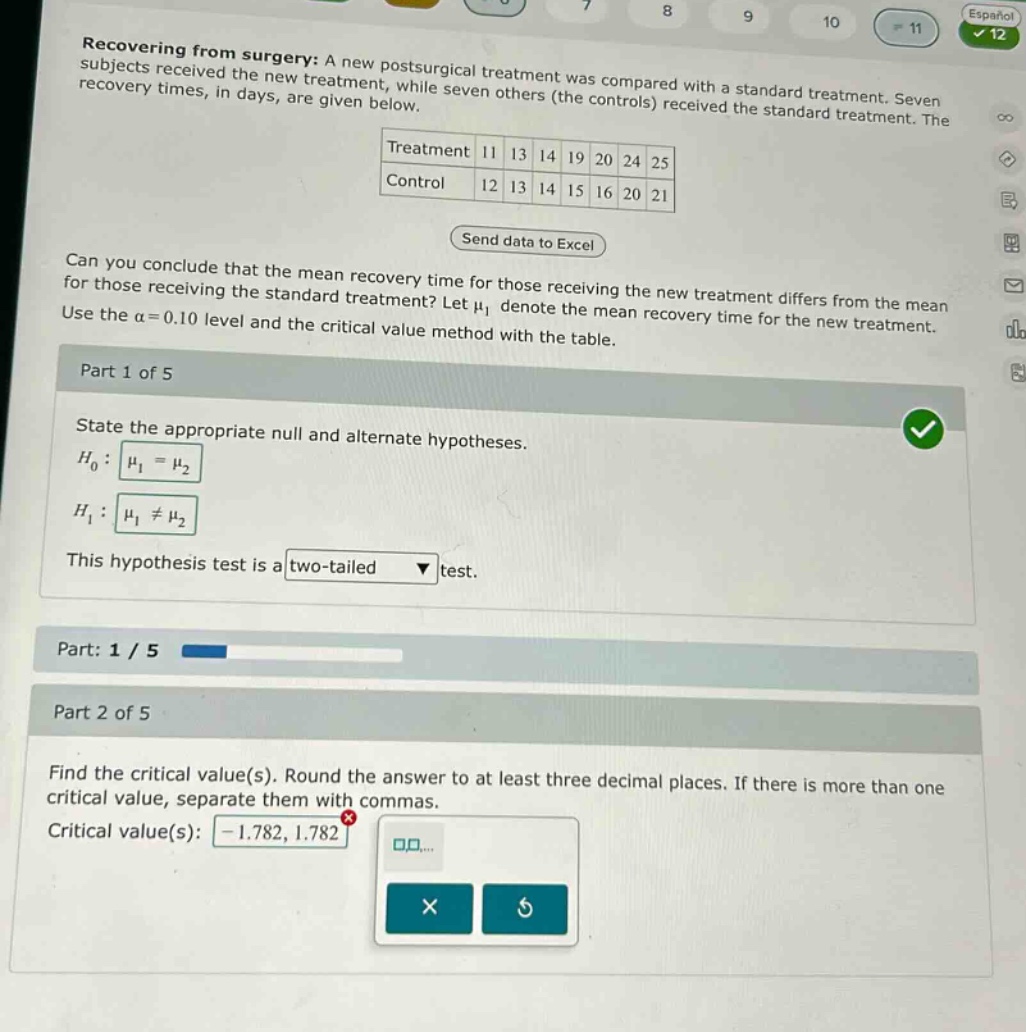
recovering from surgery: a new postsurgical treatment was compared with a standard treatment. seven subjects received the new treatment, while seven others (the controls) received the standard treatment. the recovery times, in days, are given below.\ntreatment 11 13 14 19 20 24 25\ncontrol 12 13 14 15 16 20 21\nsend data to excel\ncan you conclude that the mean recovery time for those receiving the new treatment differs from the mean for those receiving the standard treatment? let $mu_1$ denote the mean recovery time for the new treatment. use the $alpha = 0.10$ level and the critical - value method with the table.\npart 1 of 5\nstate the appropriate null and alternate hypotheses.\n$h_0:mu_1=mu_2$\n$h_1:mu_1\neqmu_2$\nthis hypothesis test is a two - tailed test.\npart: 1 / 5\npart 2 of 5\nfind the critical value(s). round the answer to at least three decimal places. if there is more than one critical value, separate them with commas.\ncritical value(s):
Answer
Explanation:
Step1: Determine degrees of freedom
Since $n_1 = n_2=7$, the degrees of freedom $df=n_1 + n_2-2=7 + 7-2 = 12$.
Step2: Find critical - value for two - tailed test
For a two - tailed test with $\alpha = 0.10$ and $df = 12$, we look up the $t$ - value in the $t$ - distribution table. The critical values are the values that cut off the $\frac{\alpha}{2}=0.05$ in each tail. Looking up in the $t$ - distribution table, the critical values are $t_{\alpha/2,df}=t_{0.05,12}$. From the table, $t_{0.05,12}=\pm 1.782$.
Answer:
$- 1.782,1.782$