the relative - frequency table shows the results of a survey in which parents were asked how much time their…
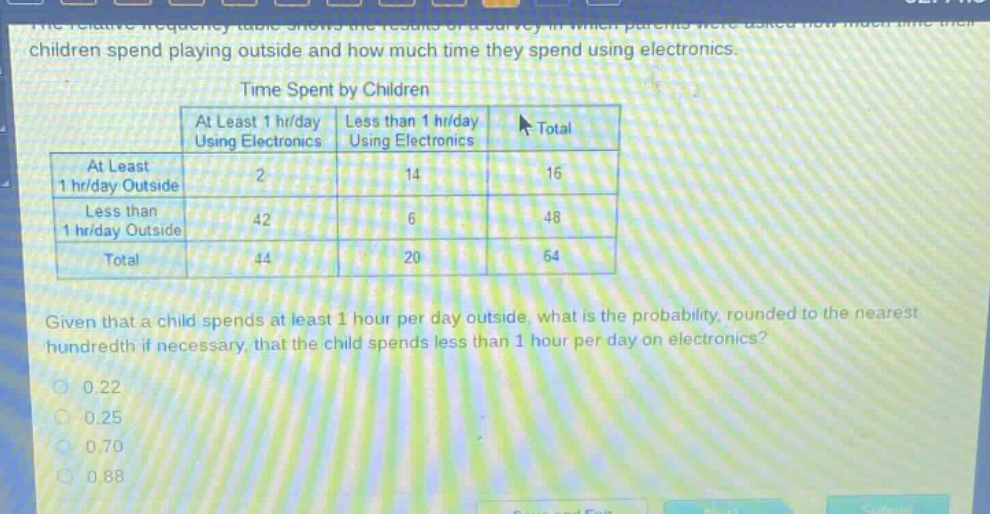
the relative - frequency table shows the results of a survey in which parents were asked how much time their children spend playing outside and how much time they spend using electronics.\ntime spent by children\n| |at least 1 hr/day using electronics|less than 1 hr/day using electronics|total|\n|--|--|--|--|\n|at least 1 hr/day outside|2|14|16|\n|less than 1 hr/day outside|42|6|48|\n|total|44|20|64|\ngiven that a child spends at least 1 hour per day outside, what is the probability, rounded to the nearest hundredth if necessary, that the child spends less than 1 hour per day on electronics?\n0.22\n0.25\n0.70\n0.88
Answer
Explanation:
Step1: Identify relevant values
We want the probability that a child spends less than 1 - hour per day on electronics given they spend at least 1 hour per day outside. The number of children who spend at least 1 hour per day outside and less than 1 hour per day on electronics is 14, and the total number of children who spend at least 1 hour per day outside is 16.
Step2: Calculate the conditional - probability
The formula for conditional probability $P(A|B)=\frac{P(A\cap B)}{P(B)}$. In the context of a frequency table, if $A$ is the event of spending less than 1 hour per day on electronics and $B$ is the event of spending at least 1 hour per day outside, then $P(A|B)=\frac{n(A\cap B)}{n(B)}$, where $n(A\cap B)$ is the number of elements in the intersection of $A$ and $B$ and $n(B)$ is the number of elements in $B$. So $P=\frac{14}{16}$.
Step3: Simplify the fraction
$\frac{14}{16}=\frac{7}{8}=0.875\approx0.88$
Answer:
0.88