required information\nhuman blood may contain either or both of two antigens, a and b. blood that contains…
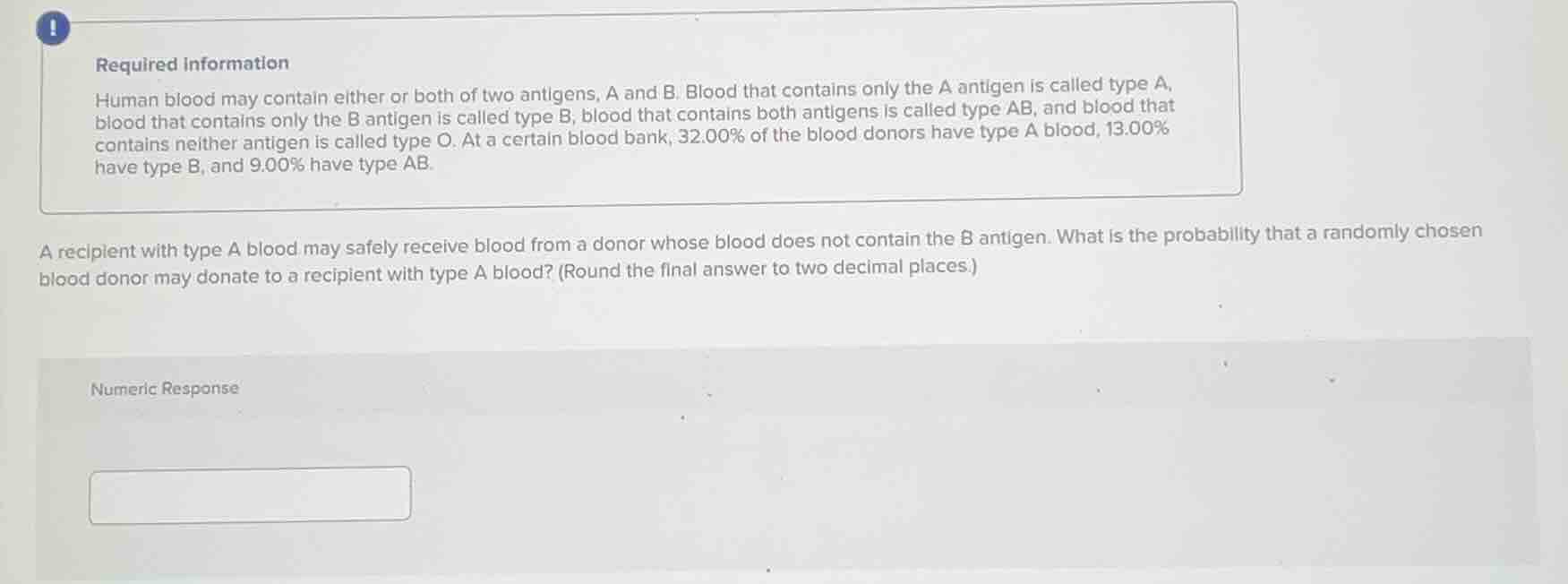
required information\nhuman blood may contain either or both of two antigens, a and b. blood that contains only the a antigen is called type a, blood that contains only the b antigen is called type b, blood that contains both antigens is called type ab, and blood that contains neither antigen is called type o. at a certain blood bank, 32.00% of the blood donors have type a blood, 13.00% have type b, and 9.00% have type ab.\na recipient with type a blood may safely receive blood from a donor whose blood does not contain the b antigen. what is the probability that a randomly chosen blood donor may donate to a recipient with type a blood? (round the final answer to two decimal places.)\nnumeric response
Answer
Explanation:
Step1: Calculate type O probability
$P(O) = 1 - 0.32 - 0.13 - 0.09 = 0.46$
Step2: Identify eligible blood types
Eligible types: A and O.
Step3: Sum eligible probabilities
$P(\text{eligible}) = 0.32 + 0.46 = 0.78$
Answer:
0.78