the research department of a board game company surveyed some shoppers at a local mall. the team asked…
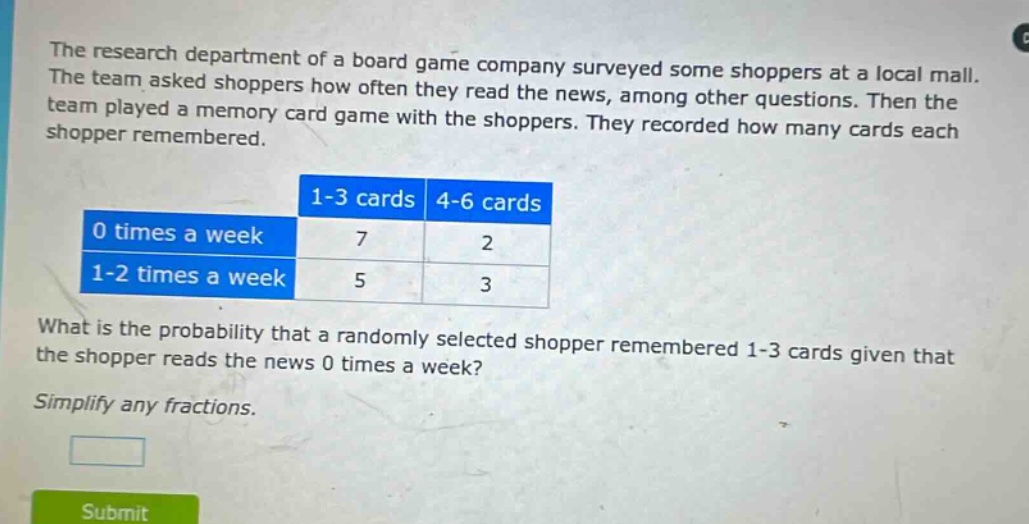
the research department of a board game company surveyed some shoppers at a local mall. the team asked shoppers how often they read the news, among other questions. then the team played a memory card game with the shoppers. they recorded how many cards each shopper remembered.\n| |1 - 3 cards|4 - 6 cards|\n|----|----|----|\n|0 times a week|7|2|\n|1 - 2 times a week|5|3|\nwhat is the probability that a randomly selected shopper remembered 1 - 3 cards given that the shopper reads the news 0 times a week?\nsimplify any fractions.
Answer
Explanation:
Step1: Identify relevant values
We want the probability of remembering 1 - 3 cards given reads news 0 times a week. The number of shoppers who read news 0 times a week and remembered 1 - 3 cards is 7, and the total number of shoppers who read news 0 times a week is (7 + 2=9).
Step2: Calculate conditional - probability
The formula for conditional probability (P(A|B)=\frac{P(A\cap B)}{P(B)}). In terms of frequency, if (A) is the event of remembering 1 - 3 cards and (B) is the event of reading news 0 times a week, the probability (P(A|B)=\frac{n(A\cap B)}{n(B)}), where (n(A\cap B) = 7) and (n(B)=9).
Answer:
(\frac{7}{9})