a research poll several years ago from a random sample of adults asked the questions \did you use the…
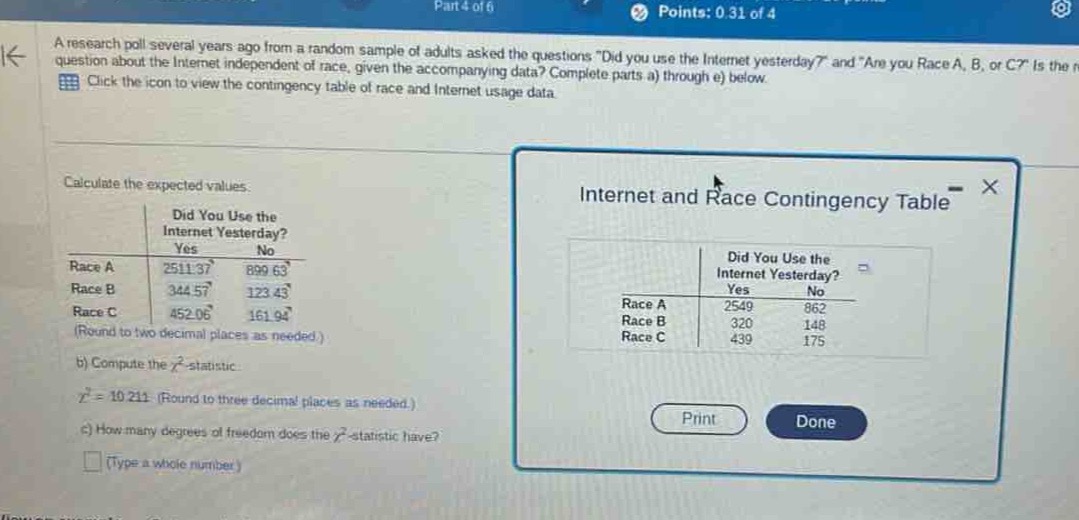
a research poll several years ago from a random sample of adults asked the questions \did you use the internet yesterday?\ and \are you race a, b, or c? is the question about the internet independent of race, given the accompanying data? complete parts a) through e) below. click the icon to view the contingency table of race and internet usage data. calculate the expected values. did you use the internet yesterday? yes no race a 2511.37 899.63 race b 344.57 123.43 race c 452.06 161.94 (round to two decimal places as needed.) b) compute the \\(\\chi^{2}\\) - statistic. \\(\\chi^{2}=10.211\\) (round to three decimal places as needed.) c) how many degrees of freedom does the \\(\\chi^{2}\\) - statistic have? (type a whole number)
Answer
Explanation:
Step1: Recall degrees - of - freedom formula
For a contingency table with $r$ rows and $c$ columns, the degrees - of - freedom formula is $df=(r - 1)(c - 1)$.
Step2: Identify number of rows and columns
The contingency table of race and Internet usage has $r = 3$ rows (Race A, Race B, Race C) and $c = 2$ columns (Yes and No for Internet usage).
Step3: Calculate degrees of freedom
Substitute $r = 3$ and $c = 2$ into the formula: $df=(3 - 1)\times(2 - 1)=2\times1 = 2$.
Answer:
2