a researcher collated data on americans leisure - time activities. she found the mean number of hours spent…
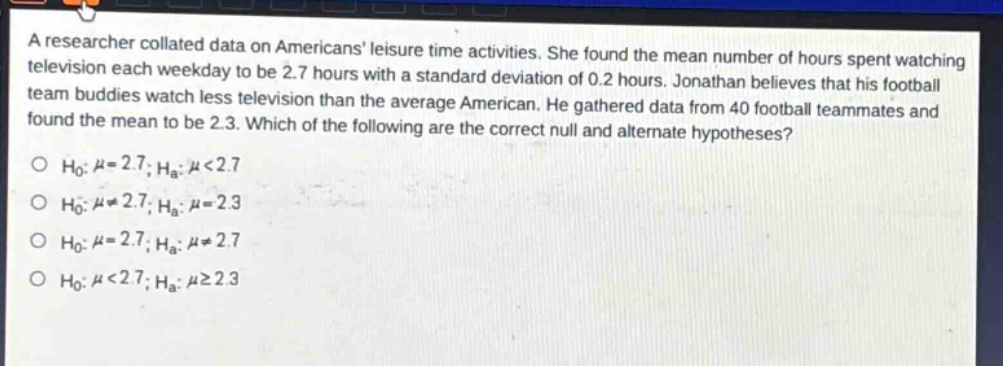
a researcher collated data on americans leisure - time activities. she found the mean number of hours spent watching television each weekday to be 2.7 hours with a standard deviation of 0.2 hours. jonathan believes that his football team buddies watch less television than the average american. he gathered data from 40 football teammates and found the mean to be 2.3. which of the following are the correct null and alternate hypotheses?\no $h_0: \\mu = 2.7; h_a: \\mu<2.7$\no $h_0: \\mu\\neq2.7; h_a: \\mu = 2.3$\no $h_0: \\mu = 2.7; h_a: \\mu\\neq2.7$\no $h_0: \\mu<2.7; h_a: \\mu\\geq2.3$
Answer
Brief Explanations:
The null hypothesis ($H_0$) is usually a statement of no - effect or equality, stating that the population mean is equal to the known population mean. The alternative hypothesis ($H_a$) is what we are trying to find evidence for. Jonathan believes his football team buddies watch less television than the average American (2.7 hours). So the null hypothesis is that the mean number of hours is 2.7, and the alternative hypothesis is that the mean is less than 2.7.
Answer:
$H_0: \mu = 2.7; H_a: \mu<2.7$