a researcher examined the actual weight, in ounces, of bags of potato chips from two different companies…
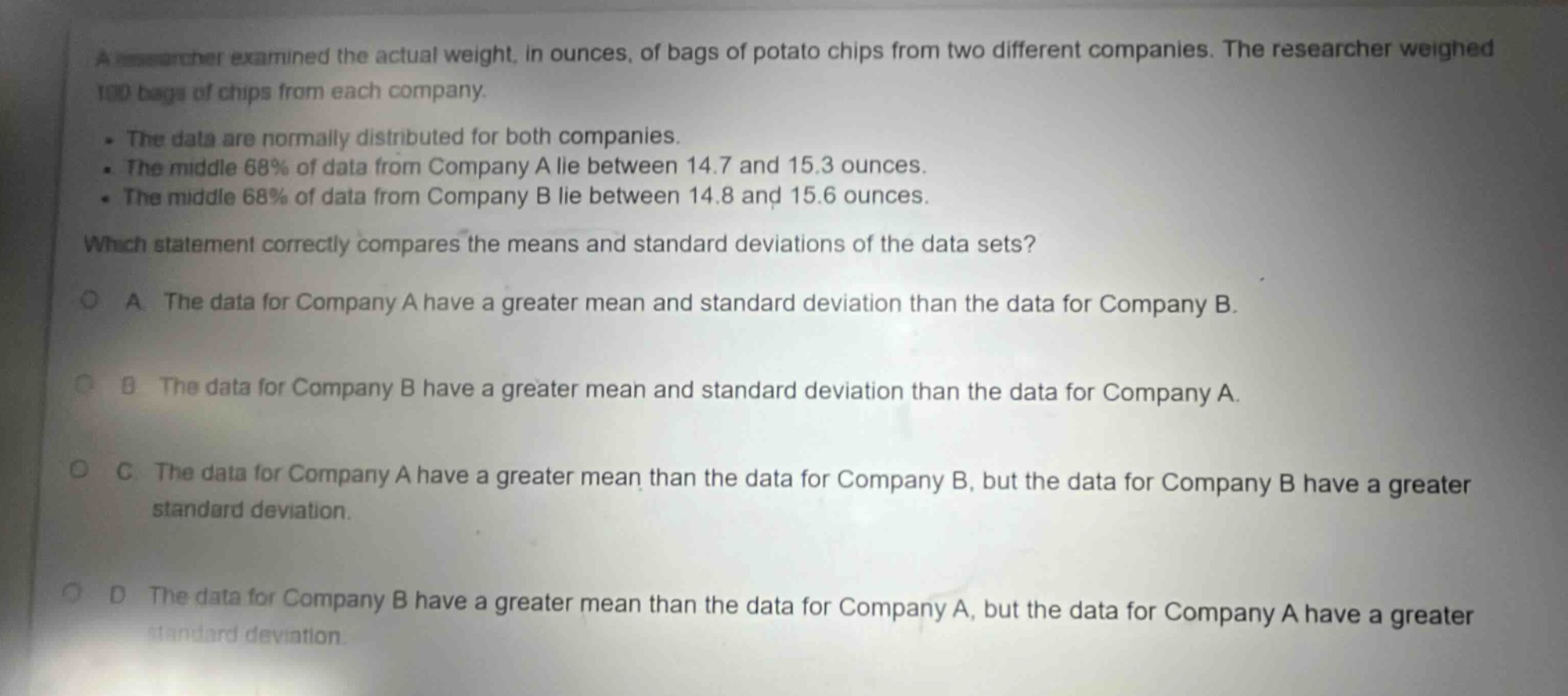
a researcher examined the actual weight, in ounces, of bags of potato chips from two different companies. the researcher weighed 100 bags of chips from each company.\n- the data are normally distributed for both companies.\n- the middle 68% of data from company a lie between 14.7 and 15.3 ounces.\n- the middle 68% of data from company b lie between 14.8 and 15.6 ounces.\nwhich statement correctly compares the means and standard deviations of the data sets?\na. the data for company a have a greater mean and standard deviation than the data for company b.\nb. the data for company b have a greater mean and standard deviation than the data for company a.\nc. the data for company a have a greater mean than the data for company b, but the data for company b have a greater standard deviation.\nd. the data for company b have a greater mean than the data for company a, but the data for company a have a greater standard deviation.
Answer
Explanation:
Step1: Recall normal - distribution property
For a normal - distributed data set, about 68% of the data lies within 1 standard deviation ($\sigma$) of the mean ($\mu$), i.e., $\mu-\sigma$ to $\mu + \sigma$.
Step2: Calculate the mean of Company A
For Company A, if $\mu-\sigma=14.7$ and $\mu+\sigma = 15.3$. We can find the mean $\mu_A$ by taking the average of the two endpoints: $\mu_A=\frac{14.7 + 15.3}{2}=\frac{30}{2}=15$ ounces. And the standard - deviation $\sigma_A=\mu_A - 14.7=15 - 14.7 = 0.3$ ounces.
Step3: Calculate the mean of Company B
For Company B, if $\mu-\sigma=14.8$ and $\mu+\sigma = 15.6$. We can find the mean $\mu_B$ by taking the average of the two endpoints: $\mu_B=\frac{14.8+15.6}{2}=\frac{30.4}{2}=15.2$ ounces. And the standard - deviation $\sigma_B=\mu_B - 14.8=15.2 - 14.8 = 0.4$ ounces.
Step4: Compare means and standard deviations
We have $\mu_A = 15$ ounces, $\sigma_A=0.3$ ounces, $\mu_B = 15.2$ ounces, and $\sigma_B = 0.4$ ounces. So, $\mu_B>\mu_A$ and $\sigma_B>\sigma_A$.
Answer:
B. The data for Company B have a greater mean and standard deviation than the data for Company A.