a restaurant owner has found that 80% of her customers return to the restaurant within two weeks. she wants…
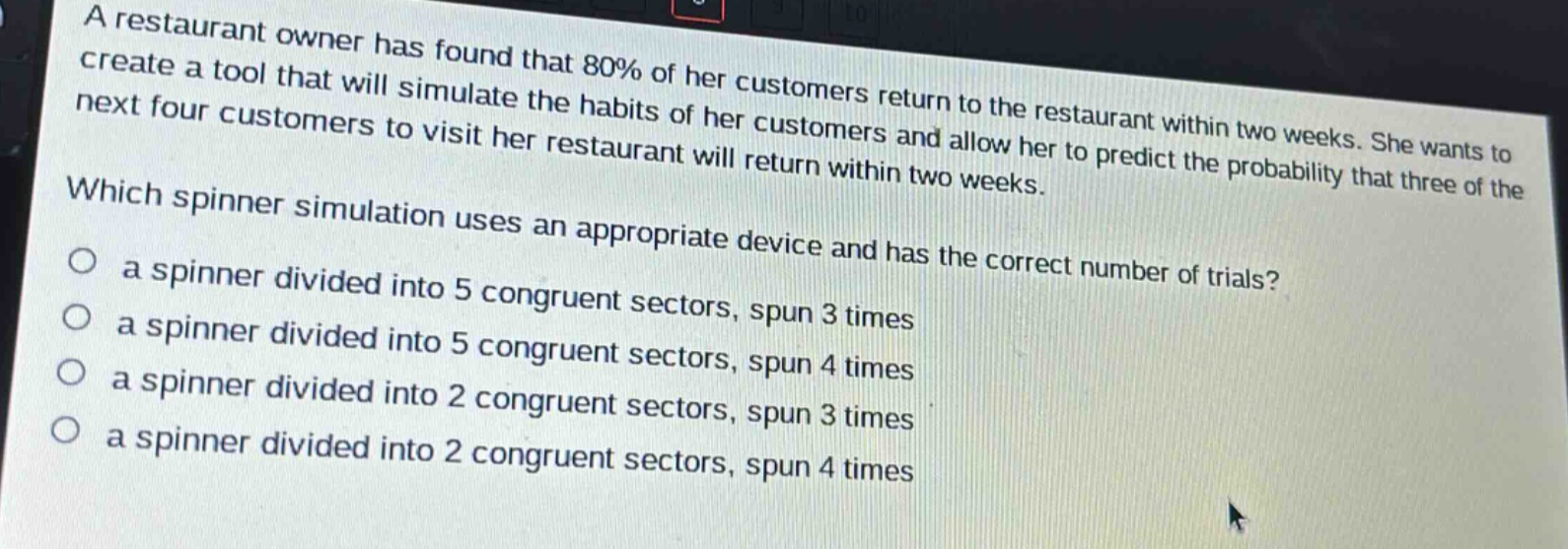
a restaurant owner has found that 80% of her customers return to the restaurant within two weeks. she wants to create a tool that will simulate the habits of her customers and allow her to predict the probability that three of the next four customers to visit her restaurant will return within two weeks. which spinner simulation uses an appropriate device and has the correct number of trials? a spinner divided into 5 congruent sectors, spun 3 times a spinner divided into 5 congruent sectors, spun 4 times a spinner divided into 2 congruent sectors, spun 3 times a spinner divided into 2 congruent sectors, spun 4 times
Answer
Explanation:
Step1: Analyze customer - return probability
The probability that a customer returns is 80% or $\frac{4}{5}$. A spinner divided into 5 congruent sectors can be used to represent this probability, where 4 out of 5 sectors can represent a returning - customer outcome.
Step2: Determine number of trials
We want to predict the probability for three out of the next four customers. So the number of trials should be equal to the number of customers, which is 4.
Answer:
a spinner divided into 5 congruent sectors, spun 4 times