the results of a survey of common allergies was organized into a venn diagram. answer the questions about…
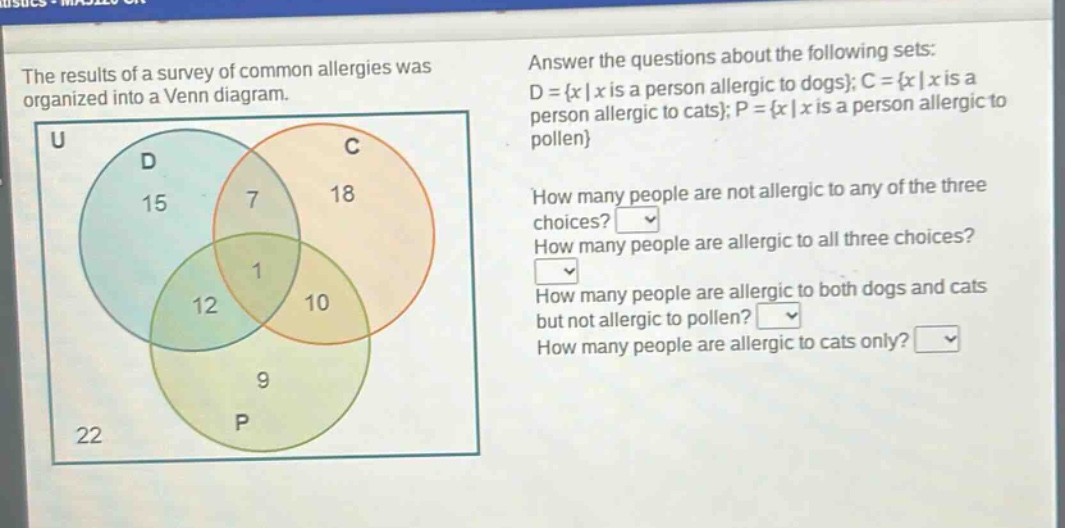
the results of a survey of common allergies was organized into a venn diagram. answer the questions about the following sets: d = {x | x is a person allergic to dogs}; c = {x | x is a person allergic to cats}; p = {x | x is a person allergic to pollen} how many people are not allergic to any of the three choices? how many people are allergic to all three choices? how many people are allergic to both dogs and cats but not allergic to pollen? how many people are allergic to cats only?
Answer
Explanation:
Step1: Identify non - allergic people
The number outside the three circles in the Venn - diagram represents people not allergic to any of the three. So, it is 22.
Step2: Identify people allergic to all three
The intersection of all three circles D, C, and P is the region with 1 person. So, the number of people allergic to all three is 1.
Step3: Identify people allergic to dogs and cats but not pollen
The intersection of D and C that is not part of P is 7. So, the number of such people is 7.
Step4: Identify people allergic to cats only
The part of circle C that does not intersect with D and P is 18. So, the number of people allergic to cats only is 18.
Answer:
How many people are not allergic to any of the three choices? 22 How many people are allergic to all three choices? 1 How many people are allergic to both dogs and cats but not allergic to pollen? 7 How many people are allergic to cats only? 18