review from previous units\n28. explain what newton’s 1st law of motion states and how it is used.\n29. how…
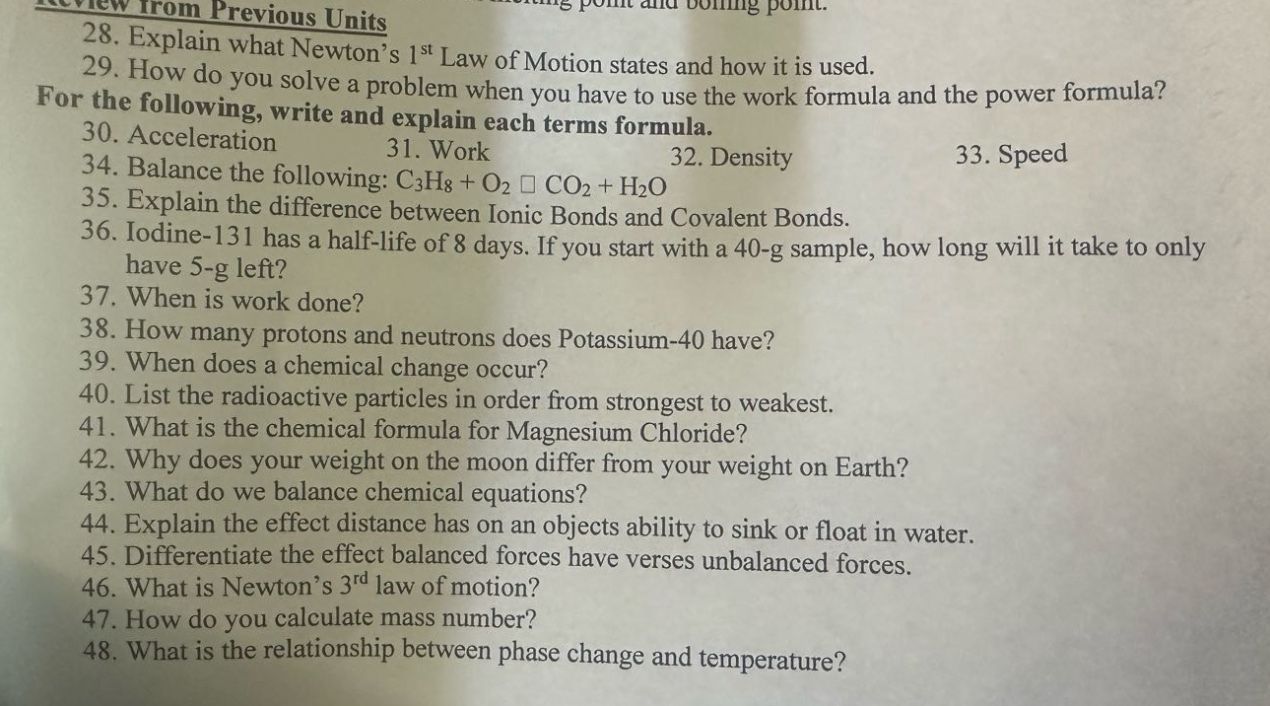
review from previous units\n28. explain what newton’s 1st law of motion states and how it is used.\n29. how do you solve a problem when you have to use the work formula and the power formula?\nfor the following, write and explain each terms formula.\n30. acceleration 31. work 32. density 33. speed\n34. balance the following: c₃h₈ + o₂ □ co₂ + h₂o\n35. explain the difference between ionic bonds and covalent bonds.\n36. iodine - 131 has a half - life of 8 days. if you start with a 40 - g sample, how long will it take to only have 5 - g left?\n37. when is work done?\n38. how many protons and neutrons does potassium - 40 have?\n39. when does a chemical change occur?\n40. list the radioactive particles in order from strongest to weakest.\n41. what is the chemical formula for magnesium chloride?\n42. why does your weight on the moon differ from your weight on earth?\n43. what do we balance chemical equations?\n44. explain the effect distance has on an objects ability to sink or float in water.\n45. differentiate the effect balanced forces have verses unbalanced forces.\n46. what is newton’s 3rd law of motion?\n47. how do you calculate mass number?\n48. what is the relationship between phase change and temperature?
Answer
Answer:
- Newton's 1st Law of Motion states that an object at rest stays at rest and an object in motion stays in motion with the same speed and in the same direction unless acted upon by an unbalanced force. It is used to understand the behavior of objects in the absence of external forces, for example, in predicting the motion of a spacecraft in deep - space where there is very little external force.
- To solve a problem using the work formula $W = F\times d$ (where $W$ is work, $F$ is force, and $d$ is distance) and the power formula $P=\frac{W}{t}$ (where $P$ is power and $t$ is time), first identify the known and unknown variables in the problem. If you know the force applied, the distance over which the force is applied, and the time taken, you can calculate work using the work formula and then power using the power formula.
- Acceleration ($a$) is defined as the rate of change of velocity. The formula is $a=\frac{\Delta v}{\Delta t}$, where $\Delta v$ is the change in velocity and $\Delta t$ is the change in time.
- Work ($W$) is the product of force and displacement in the direction of the force. The formula is $W = F\times d$. Here, $F$ is the force applied and $d$ is the displacement of the object in the direction of the force.
- Density ($\rho$) is defined as mass per unit volume. The formula is $\rho=\frac{m}{V}$, where $m$ is the mass of the object and $V$ is its volume.
- Speed ($v$) is the distance traveled per unit time. The formula is $v=\frac{d}{t}$, where $d$ is the distance traveled and $t$ is the time taken.
- The balanced chemical equation is $C_{3}H_{8}+5O_{2}\rightarrow3CO_{2}+4H_{2}O$.
- Ionic bonds are formed by the transfer of electrons from a metal to a non - metal, resulting in the formation of ions that are held together by electrostatic forces. Covalent bonds are formed by the sharing of electrons between non - metals.
- The half - life formula is $N = N_{0}(\frac{1}{2})^{\frac{t}{T_{1/2}}}$, where $N$ is the final amount, $N_{0}$ is the initial amount, $t$ is the time elapsed, and $T_{1/2}$ is the half - life. Given $N_{0}=40$ g, $N = 5$ g, and $T_{1/2}=8$ days.
- First, substitute the values into the formula: $5 = 40(\frac{1}{2})^{\frac{t}{8}}$.
- Then, $\frac{5}{40}=(\frac{1}{2})^{\frac{t}{8}}$, so $\frac{1}{8}=(\frac{1}{2})^{\frac{t}{8}}$.
- Since $\frac{1}{8}=(\frac{1}{2})^{3}$, we have $\frac{t}{8}=3$, and $t = 24$ days.
- Work is done when a force causes an object to move in the direction of the force. Mathematically, $W = F\times d$ (where $d$ is the displacement in the direction of the force).
- Potassium has an atomic number of 19. For Potassium - 40, the number of protons ($p$) is equal to the atomic number, so $p = 19$. The mass number ($A$) is 40. The number of neutrons ($n$) is calculated as $n=A - p$, so $n=40 - 19=21$.
- A chemical change occurs when a substance undergoes a reaction and forms one or more new substances with different chemical properties. For example, when iron rusts, iron reacts with oxygen to form iron oxide, a new substance.
- The radioactive particles in order from strongest to weakest in terms of penetrating power are gamma rays, beta particles, and alpha particles.
- The chemical formula for Magnesium Chloride is $MgCl_{2}$. Magnesium has a + 2 charge ($Mg^{2 + }$) and chlorine has a - 1 charge ($Cl^{-}$), so two chlorine atoms are needed to balance the charge of one magnesium atom.
- Weight is the force exerted on an object due to gravity, $W = mg$ (where $m$ is mass and $g$ is the acceleration due to gravity). The acceleration due to gravity on the moon ($g_{moon}$) is about one - sixth of that on Earth ($g_{earth}$). Since mass is constant, your weight on the moon is less than your weight on Earth because $W_{moon}=m\times g_{moon}$ and $W_{earth}=m\times g_{earth}$ and $g_{moon}<g_{earth}$.
- We balance chemical equations to satisfy the law of conservation of mass. This law states that matter cannot be created or destroyed in a chemical reaction, so the number of atoms of each element on the reactant side must equal the number of atoms of each element on the product side.
- The distance of an object from the surface of the water does not directly affect its ability to sink or float. Whether an object sinks or floats depends on its density compared to the density of water. If the object's density is greater than water's density, it sinks; if it is less, it floats.
- Balanced forces acting on an object result in no change in the object's motion (it remains at rest or moves with a constant velocity). Unbalanced forces cause the object to accelerate in the direction of the net force.
- Newton's 3rd law of motion states that for every action, there is an equal and opposite reaction. Forces always occur in pairs.
- The mass number ($A$) of an atom is calculated as the sum of the number of protons ($p$) and neutrons ($n$) in the nucleus of the atom, $A=p + n$.
- During a phase change (such as melting, freezing, boiling, or condensing), the temperature remains constant while heat is being absorbed or released. The heat energy is used to break or form intermolecular forces rather than increasing or decreasing the temperature of the substance.
Explanation:
- The law is a fundamental concept in physics. Its applications are wide - ranging in understanding motion.
- Identify variables and apply formulas.
- Based on the definition of acceleration as a rate of change.
- From the basic concept of work in physics.
- Definition of density in terms of mass and volume.
- Definition of speed in terms of distance and time.
- Use the law of conservation of mass to balance atoms on both sides.
- Based on the nature of electron transfer and sharing in bonding.
- Apply the half - life formula and solve for time.
- According to the work - force - displacement relationship.
- Use the atomic number and mass number relationship.
- Based on the concept of chemical reactions forming new substances.
- Knowledge of the properties of radioactive particles.
- Based on the charges of ions to form a neutral compound.
- Using the weight formula and the difference in gravitational accelerations.
- Conservation of mass is the key principle.
- Density is the determining factor for floating or sinking, not distance.
- Understanding of the effect of forces on motion.
- A well - known law in physics about force pairs.
- Definition of mass number in terms of sub - atomic particles.
- Phase change involves energy for intermolecular forces, not temperature change.