roll the number cube to find the observed frequency. which statements are true? check all that apply. as the…
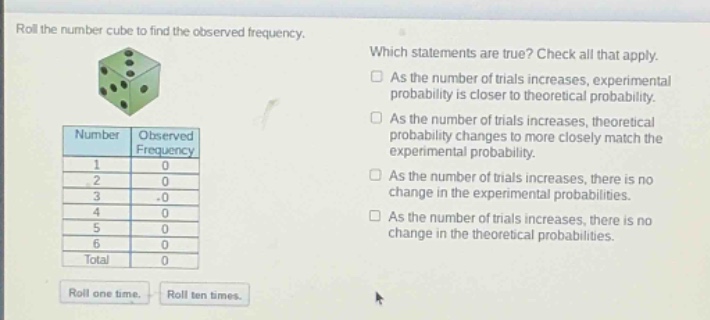
roll the number cube to find the observed frequency. which statements are true? check all that apply. as the number of trials increases, experimental probability is closer to theoretical probability. as the number of trials increases, theoretical probability changes to more closely match the experimental probability. as the number of trials increases, there is no change in the experimental probabilities. as the number of trials increases, there is no change in the theoretical probabilities. number observed frequency 1 0 2 0 3 0 4 0 5 0 6 0 total 0 roll one time. roll ten times.
Answer
Answer:
A. As the number of trials increases, experimental probability is closer to theoretical probability. D. As the number of trials increases, there is no change in the theoretical probabilities.
Explanation:
Step1: Understand theoretical probability
Theoretical probability of getting any number on a fair - six - sided die is $\frac{1}{6}$ and it does not change with the number of trials.
Step2: Understand experimental probability
Experimental probability is based on the results of actual trials. As the number of trials increases, the experimental probability of an event gets closer to its theoretical probability. For example, if we roll a die a small number of times, the proportion of times we get a particular number may be very different from $\frac{1}{6}$, but as we roll it many times, this proportion will approach $\frac{1}{6}$.