ron randomly pulls a pen out of a box that contains 1 red, 2 black, and 3 blue pens. he does this 4 times…
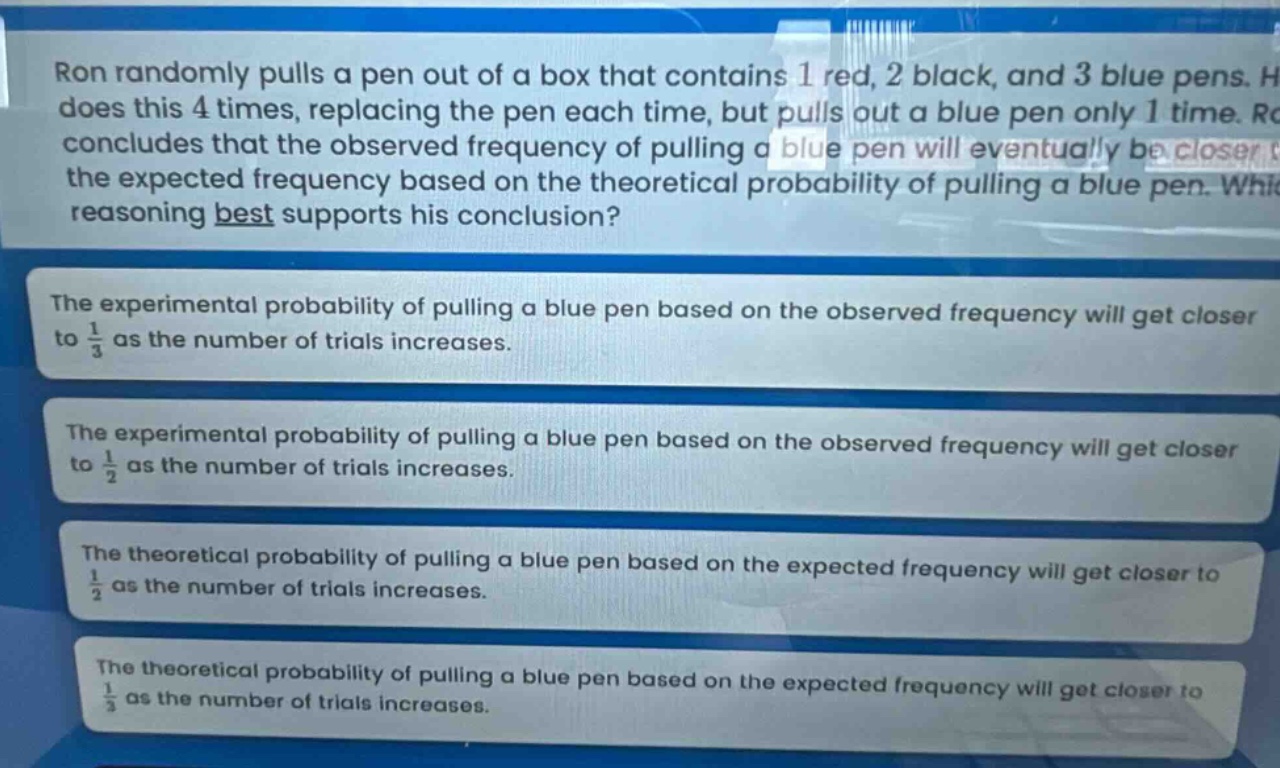
ron randomly pulls a pen out of a box that contains 1 red, 2 black, and 3 blue pens. he does this 4 times, replacing the pen each time, but pulls out a blue pen only 1 time. ron concludes that the observed frequency of pulling a blue pen will eventually be closer to the expected frequency based on the theoretical probability of pulling a blue pen. which reasoning best supports his conclusion? the experimental probability of pulling a blue pen based on the observed frequency will get closer to $\frac{1}{3}$ as the number of trials increases. the experimental probability of pulling a blue pen based on the observed frequency will get closer to $\frac{1}{2}$ as the number of trials increases. the theoretical probability of pulling a blue pen based on the expected frequency will get closer to $\frac{1}{2}$ as the number of trials increases. the theoretical probability of pulling a blue pen based on the expected frequency will get closer to $\frac{1}{3}$ as the number of trials increases.
Answer
Explanation:
Step1: Calculate total number of pens
There are $1 + 2+3=6$ pens.
Step2: Calculate theoretical probability of pulling a blue pen
The number of blue pens is 3. So the theoretical probability $P=\frac{3}{6}=\frac{1}{2}$.
Step3: Recall law of large - numbers concept
As the number of trials increases, the experimental probability (based on observed frequency) gets closer to the theoretical probability.
Answer:
The experimental probability of pulling a blue pen based on the observed frequency will get closer to $\frac{1}{2}$ as the number of trials increases.