ryan has a bag that contains strawberry chews, cherry chews, and watermelon chews. he performs an…
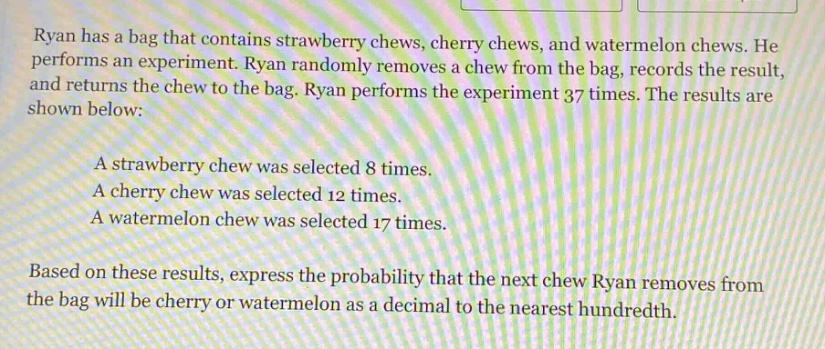
ryan has a bag that contains strawberry chews, cherry chews, and watermelon chews. he performs an experiment. ryan randomly removes a chew from the bag, records the result, and returns the chew to the bag. ryan performs the experiment 37 times. the results are shown below:\na strawberry chew was selected 8 times.\na cherry chew was selected 12 times.\na watermelon chew was selected 17 times.\nbased on these results, express the probability that the next chew ryan removes from the bag will be cherry or watermelon as a decimal to the nearest hundredth.
Answer
Explanation:
Step1: Find the number of cherry or watermelon chews selected
The number of cherry chews selected is (12), and the number of watermelon chews selected is (17). So the number of cherry or watermelon chews selected is (12 + 17=29).
Step2: Calculate the probability
The total number of experiments is (n = 37). The probability (P) of an event is given by the formula (P=\frac{\text{Number of favorable outcomes}}{\text{Total number of outcomes}}). So (P=\frac{29}{37}). Using a calculator, (\frac{29}{37}\approx0.78)
Answer:
(0.78)