ryan gathered data about the age of the different dogs in his neighborhood and the length of their tails…
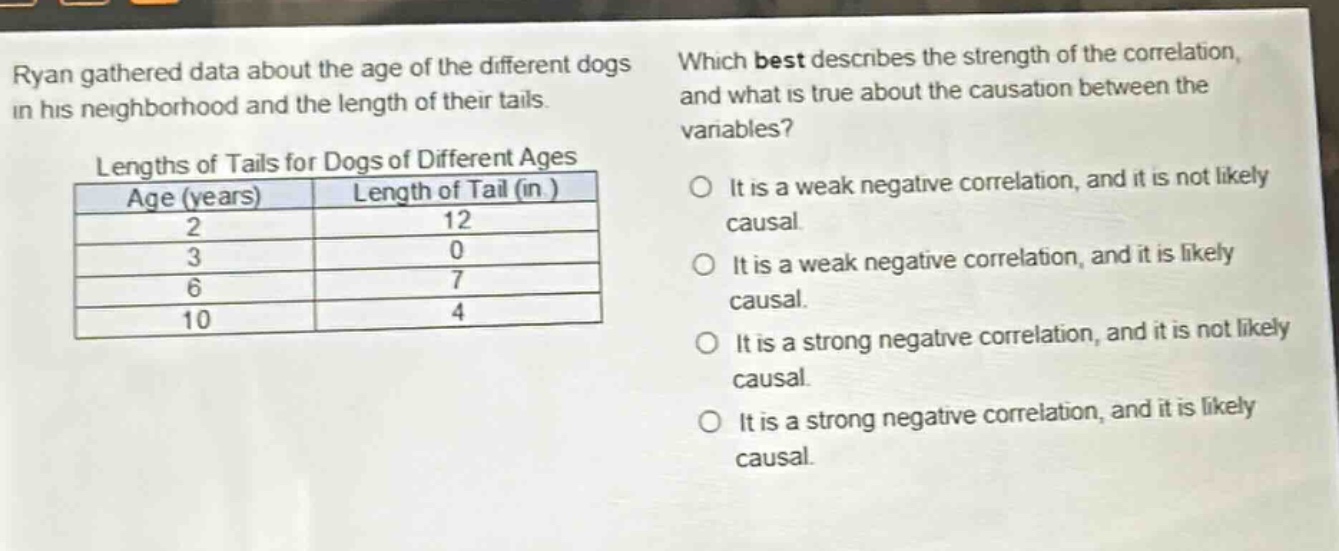
ryan gathered data about the age of the different dogs in his neighborhood and the length of their tails. which best describes the strength of the correlation, and what is true about the causation between the variables? lengths of tails for dogs of different ages age (years) length of tail (in ) 2 12 3 0 6 7 10 4 it is a weak negative correlation, and it is not likely causal. it is a weak negative correlation, and it is likely causal. it is a strong negative correlation, and it is not likely causal. it is a strong negative correlation, and it is likely causal.
Answer
Explanation:
Step1: Analyze the data trend
As age increases (2, 3, 6, 10), tail - length (12, 0, 7, 4) does not show a very consistent decrease. There is a lot of variability. So, the correlation is weak.
Step2: Consider causation
There is no scientific reason to believe that a dog's age directly causes its tail - length to change in a particular way. So, it is not likely causal.
Answer:
It is a weak negative correlation, and it is not likely causal.