the sample space, s, of a coin being tossed three times is shown below, where h and t denote the coin…
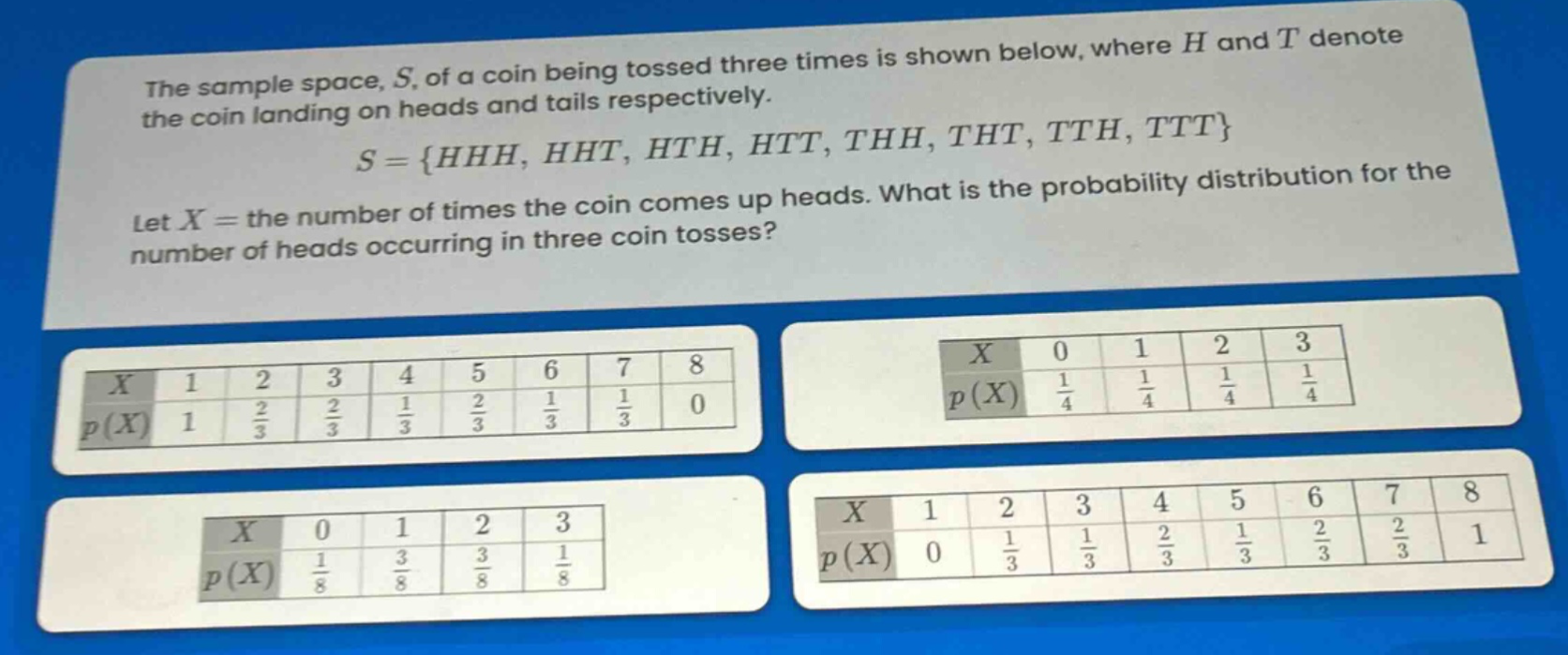
the sample space, s, of a coin being tossed three times is shown below, where h and t denote the coin landing on heads and tails respectively.\ns = {hhh, hht, hth, htt, thh, tht, tth, ttt}\nlet x = the number of times the coin comes up heads. what is the probability distribution for the number of heads occurring in three coin tosses?
Answer
Explanation:
Step1: Count the number of elements in the sample space
The sample space ( S={HHH, HHT, HTH, HTT, THH, THT, TTH, TTT} ), so ( n(S) = 8 ).
Step2: Calculate ( P(X = 0) )
The outcome with ( 0 ) heads is ( TTT ). So ( n(X = 0)=1 ), and ( P(X = 0)=\frac{n(X = 0)}{n(S)}=\frac{1}{8} ).
Step3: Calculate ( P(X = 1) )
The outcomes with ( 1 ) head are ( HTT,THT,TTH ). So ( n(X = 1)=3 ), and ( P(X = 1)=\frac{n(X = 1)}{n(S)}=\frac{3}{8} ).
Step4: Calculate ( P(X = 2) )
The outcomes with ( 2 ) heads are ( HHT,HTH,THH ). So ( n(X = 2)=3 ), and ( P(X = 2)=\frac{n(X = 2)}{n(S)}=\frac{3}{8} ).
Step5: Calculate ( P(X = 3) )
The outcome with ( 3 ) heads is ( HHH ). So ( n(X = 3)=1 ), and ( P(X = 3)=\frac{n(X = 3)}{n(S)}=\frac{1}{8} ).
Answer:
The probability distribution is ( \begin{array}{|c|c|c|c|c|}\hline X&0&1&2&3\\hline p(X)&\frac{1}{8}&\frac{3}{8}&\frac{3}{8}&\frac{1}{8}\\hline\end{array} ) (the third table in the given options).