3.3: sample space practice\nnote: all coins and number cubes mentioned in this unit are assumed to be fair…
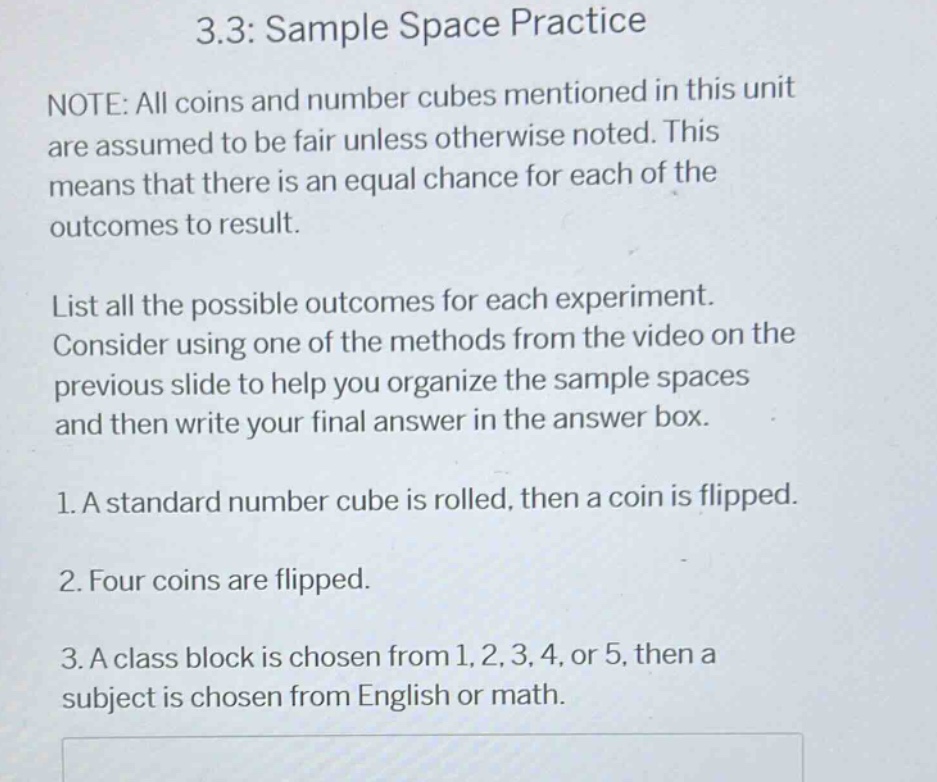
3.3: sample space practice\nnote: all coins and number cubes mentioned in this unit are assumed to be fair unless otherwise noted. this means that there is an equal chance for each of the outcomes to result.\nlist all the possible outcomes for each experiment. consider using one of the methods from the video on the previous slide to help you organize the sample spaces and then write your final answer in the answer box.\n1. a standard number cube is rolled, then a coin is flipped.\n2. four coins are flipped.\n3. a class block is chosen from 1, 2, 3, 4, or 5, then a subject is chosen from english or math.
Answer
Explanation:
Step1: Analyze first experiment
A standard number - cube has 6 outcomes (1, 2, 3, 4, 5, 6) and a coin flip has 2 outcomes (heads, tails). By the multiplication principle, the total number of combined outcomes is the product of the number of outcomes of each event. The sample - space is ((1, H),(1, T),(2, H),(2, T),(3, H),(3, T),(4, H),(4, T),(5, H),(5, T),(6, H),(6, T))
Step2: Analyze second experiment
Each coin flip has 2 outcomes. When 4 coins are flipped, by the multiplication principle, the total number of outcomes is (2\times2\times2\times2 = 2^4=16). The sample - space is ((HHHH),(HHHT),(HHTH),(HHTT),(HTHH),(HTHT),(HTTH),(HTTT),(THHH),(THHT),(THTH),(THTT),(TTHH),(TTHT),(TTTH),(TTTT))
Step3: Analyze third experiment
There are 5 choices for the class block (1, 2, 3, 4, 5) and 2 choices for the subject (English, math). By the multiplication principle, the total number of combined outcomes is (5\times2 = 10). The sample - space is ((1, English),(1, math),(2, English),(2, math),(3, English),(3, math),(4, English),(4, math),(5, English),(5, math))
Answer:
- ((1, H),(1, T),(2, H),(2, T),(3, H),(3, T),(4, H),(4, T),(5, H),(5, T),(6, H),(6, T))
- ((HHHH),(HHHT),(HHTH),(HHTT),(HTHH),(HTHT),(HTTH),(HTTT),(THHH),(THHT),(THTH),(THTT),(TTHH),(TTHT),(TTTH),(TTTT))
- ((1, English),(1, math),(2, English),(2, math),(3, English),(3, math),(4, English),(4, math),(5, English),(5, math))