when samuel commutes to work, the amount of time it takes him to arrive is normally distributed with a mean…
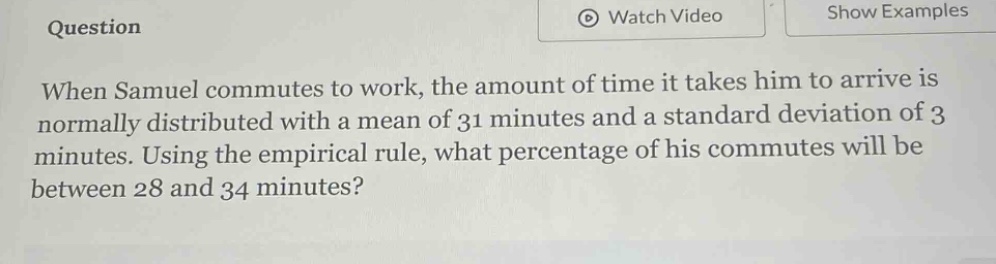
when samuel commutes to work, the amount of time it takes him to arrive is normally distributed with a mean of 31 minutes and a standard deviation of 3 minutes. using the empirical rule, what percentage of his commutes will be between 28 and 34 minutes?
Answer
Explanation:
Step1: Recall empirical rule
The empirical rule for a normal - distribution states that about 68% of the data lies within 1 standard deviation of the mean, about 95% lies within 2 standard deviations of the mean, and about 99.7% lies within 3 standard deviations of the mean.
Step2: Calculate the number of standard - deviations
The mean $\mu = 31$ minutes and the standard deviation $\sigma=3$ minutes. For the lower bound: $31 - 28=3=\sigma$. For the upper bound: $34 - 31 = 3=\sigma$. So, the values 28 and 34 are 1 standard deviation below and above the mean respectively.
Answer:
68%