samuel uses a uniform probability model for an experiment using a deck of 30 cards. there are 6 blue cards…
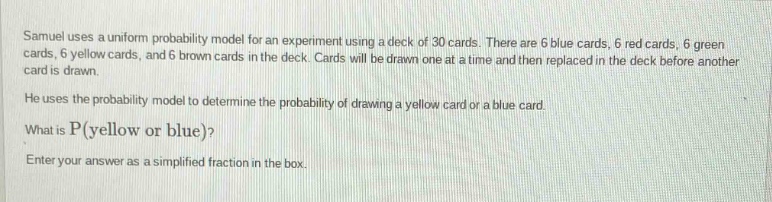
samuel uses a uniform probability model for an experiment using a deck of 30 cards. there are 6 blue cards, 6 red cards, 6 green cards, 6 yellow cards, and 6 brown cards in the deck. cards will be drawn one at a time and then replaced in the deck before another card is drawn. he uses the probability model to determine the probability of drawing a yellow card or a blue card. what is p(yellow or blue)? enter your answer as a simplified fraction in the box.
Answer
Explanation:
Step1: Find probability of yellow card
The probability of an event $P(E)=\frac{\text{Number of favorable outcomes}}{\text{Total number of outcomes}}$. There are 6 yellow cards and 30 total cards. So $P(\text{yellow})=\frac{6}{30}$.
Step2: Find probability of blue card
There are 6 blue cards and 30 total cards. So $P(\text{blue})=\frac{6}{30}$.
Step3: Use addition - rule for mutually - exclusive events
Since drawing a yellow card and a blue card are mutually - exclusive events (a card can't be both yellow and blue at the same time), $P(\text{yellow or blue})=P(\text{yellow})+P(\text{blue})$. $P(\text{yellow or blue})=\frac{6}{30}+\frac{6}{30}=\frac{6 + 6}{30}=\frac{12}{30}$.
Step4: Simplify the fraction
$\frac{12}{30}=\frac{12\div6}{30\div6}=\frac{2}{5}$.
Answer:
$\frac{2}{5}$