p(a or b)=p(a)+p(b)-p(a and b)\nsarah has 52 balloons; 13 of the balloons are red, and 4 of the balloons…
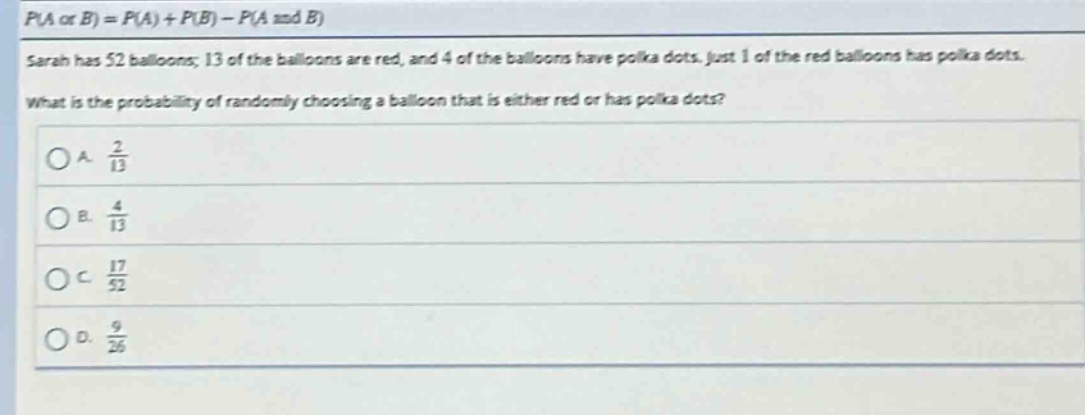
p(a or b)=p(a)+p(b)-p(a and b)\nsarah has 52 balloons; 13 of the balloons are red, and 4 of the balloons have polka dots. just 1 of the red balloons has polka dots.\nwhat is the probability of randomly choosing a balloon that is either red or has polka dots?\na. $\frac{2}{13}$\nb. $\frac{4}{13}$\nc. $\frac{17}{52}$\nd. $\frac{9}{26}$
Answer
Explanation:
Step1: Calculate P(A), P(B), P(A and B)
Let event A be choosing a red balloon and event B be choosing a polka - dot balloon. Total number of balloons (n = 52). (P(A)=\frac{13}{52}), (P(B)=\frac{4}{52}), (P(A\ and\ B)=\frac{1}{52}).
Step2: Apply the formula (P(A\ or\ B)=P(A)+P(B)-P(A\ and\ B))
[ \begin{align*} P(A\ or\ B)&=\frac{13}{52}+\frac{4}{52}-\frac{1}{52}\ &=\frac{13 + 4-1}{52}\ &=\frac{16}{52}\ &=\frac{4}{13} \end{align*} ]
Answer:
B. (\frac{4}{13})