sarah has 52 balloons; 13 of the balloons are red, and 4 of the balloons have polka dots. just 1 of the red…
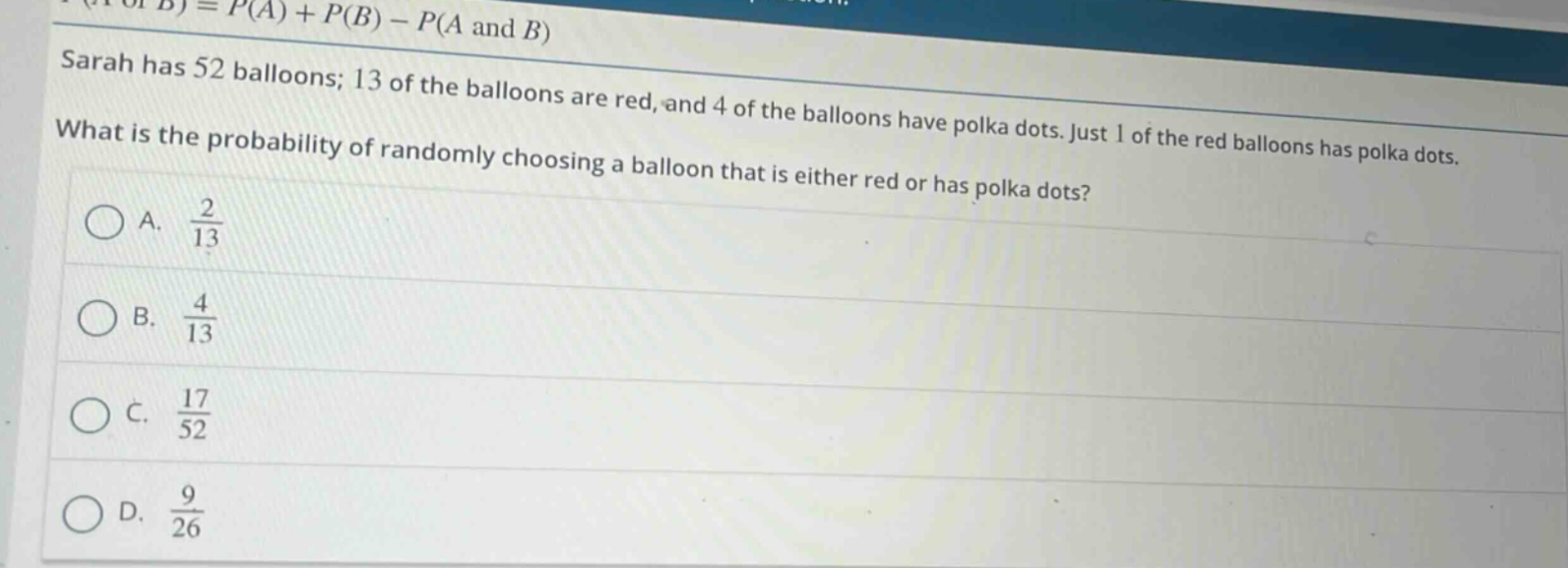
sarah has 52 balloons; 13 of the balloons are red, and 4 of the balloons have polka dots. just 1 of the red balloons has polka dots. what is the probability of randomly choosing a balloon that is either red or has polka dots?\na. $\frac{2}{13}$\nb. $\frac{4}{13}$\nc. $\frac{17}{52}$\nd. $\frac{9}{26}$
Answer
Explanation:
Step1: Define the events and total number
Let event $A$ be choosing a red balloon, event $B$ be choosing a polka - dot balloon. Total number of balloons $n = 52$. $n(A)=13$, $n(B) = 4$, $n(A\cap B)=1$.
Step2: Calculate probabilities of individual and intersection events
$P(A)=\frac{n(A)}{n}=\frac{13}{52}$, $P(B)=\frac{n(B)}{n}=\frac{4}{52}$, $P(A\cap B)=\frac{n(A\cap B)}{n}=\frac{1}{52}$.
Step3: Use the addition rule of probability
$P(A\cup B)=P(A)+P(B)-P(A\cap B)$. Substitute the values: $P(A\cup B)=\frac{13}{52}+\frac{4}{52}-\frac{1}{52}=\frac{13 + 4-1}{52}=\frac{16}{52}=\frac{4}{13}$.
Answer:
B. $\frac{4}{13}$