on the sat exam, a total of 25 minutes is allotted for students to answer 20 math questions without the use…
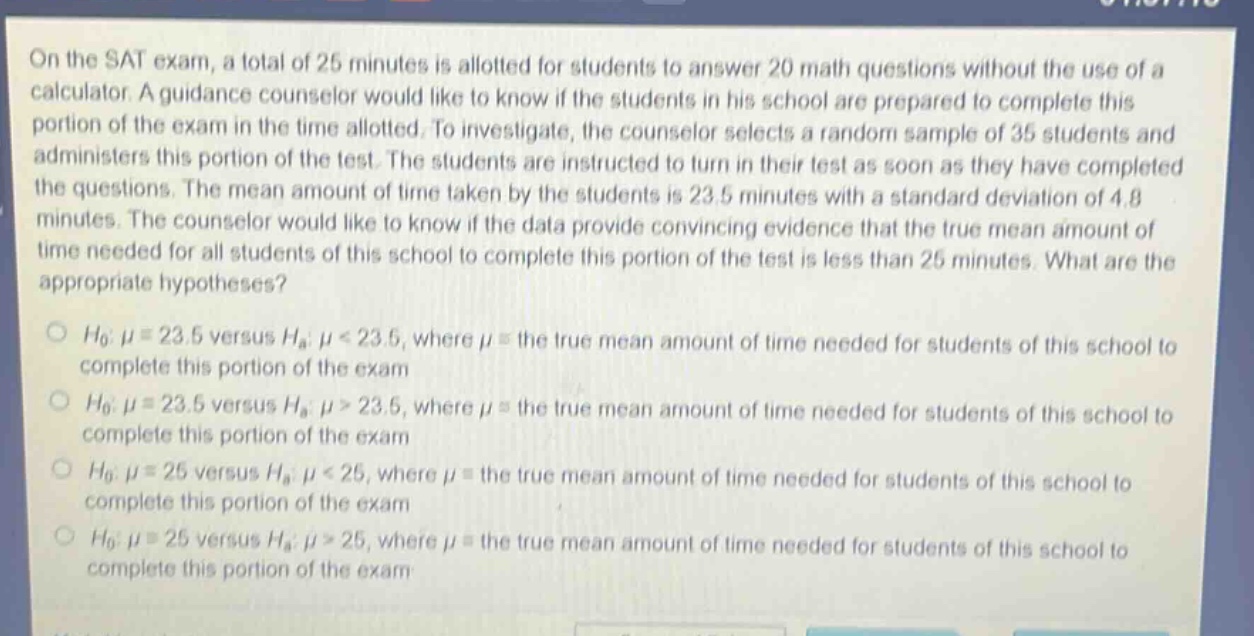
on the sat exam, a total of 25 minutes is allotted for students to answer 20 math questions without the use of a calculator. a guidance counselor would like to know if the students in his school are prepared to complete this portion of the exam in the time allotted. to investigate, the counselor selects a random sample of 35 students and administers this portion of the test. the students are instructed to turn in their test as soon as they have completed the questions. the mean amount of time taken by the students is 23.5 minutes with a standard deviation of 4.8 minutes. the counselor would like to know if the data provide convincing evidence that the true mean amount of time needed for all students of this school to complete this portion of the test is less than 25 minutes. what are the appropriate hypotheses?\n\n$h_0: mu = 23.5$ versus $h_a: mu < 23.5$, where $mu$ = the true mean amount of time needed for students of this school to complete this portion of the exam\n\n$h_0: mu = 23.5$ versus $h_a: mu > 23.5$, where $mu$ = the true mean amount of time needed for students of this school to complete this portion of the exam\n\n$h_0: mu = 25$ versus $h_a: mu < 25$, where $mu$ = the true mean amount of time needed for students of this school to complete this portion of the exam\n\n$h_0: mu = 25$ versus $h_a: mu > 25$, where $mu$ = the true mean amount of time needed for students of this school to complete this portion of the exam
Answer
Explanation:
Step1: Identify the null hypothesis
The null hypothesis $H_0$ is usually a statement of no - effect or equality. Here, the benchmark time is 25 minutes. So, $H_0:\mu = 25$.
Step2: Identify the alternative hypothesis
The counselor wants to know if the true mean amount of time needed for all students of this school to complete this portion of the test is less than 25 minutes. So, the alternative hypothesis $H_a:\mu<25$, where $\mu$ is the true mean amount of time needed for students of this school to complete this portion of the exam.
Answer:
$H_0:\mu = 25$ versus $H_a:\mu<25$, where $\mu$ = the true mean amount of time needed for students of this school to complete this portion of the exam