in a school, 20% of the students have blue eyes. find the experimental probability that in a group of 4…
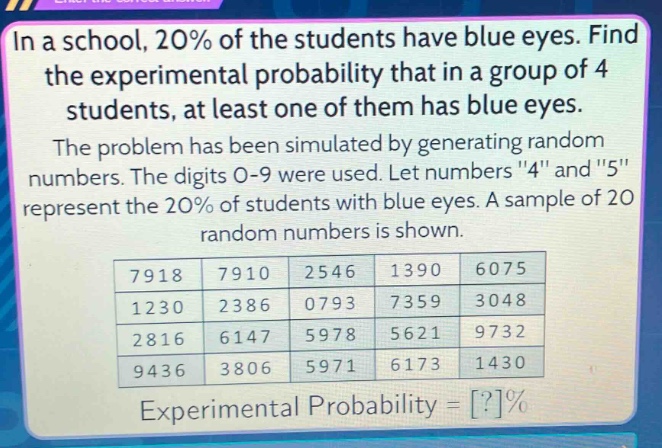
in a school, 20% of the students have blue eyes. find the experimental probability that in a group of 4 students, at least one of them has blue eyes. the problem has been simulated by generating random numbers. the digits 0 - 9 were used. let numbers \4\ and \5\ represent the 20% of students with blue eyes. a sample of 20 random numbers is shown.\n7918 7910 2546 1390 6075\n1230 2386 0793 7359 3048\n2816 6147 5978 5621 9732\n9436 3806 5971 6173 1430\nexperimental probability = ?%
Answer
Explanation:
Step1: Count total groups
There are 20 groups of 4 - digit random numbers. So the total number of trials (n = 20).
Step2: Count groups with at - least one 4 or 5
We check each group of 4 digits for the presence of 4 or 5.
- For 7918: No 4 or 5.
- For 7910: No 4 or 5.
- For 2546: Has 4 and 5.
- For 1390: No 4 or 5.
- For 6075: Has 5.
- For 1230: No 4 or 5.
- For 2386: No 4 or 5.
- For 0793: No 4 or 5.
- For 7359: Has 5.
- For 3048: Has 4.
- For 2816: No 4 or 5.
- For 6147: Has 4.
- For 5978: Has 5.
- For 5621: Has 5.
- For 9732: No 4 or 5.
- For 9436: Has 4.
- For 3806: No 4 or 5.
- For 5971: Has 5.
- For 6173: No 4 or 5.
- For 1430: Has 4. The number of groups with at least one 4 or 5 is (m=11).
Step3: Calculate experimental probability
The experimental probability (P=\frac{m}{n}\times100%). Substituting (m = 11) and (n = 20), we get (P=\frac{11}{20}\times100%=55%).
Answer:
55%