a school district needs to arrange transportation for at least 360 students for a field trip. the district…
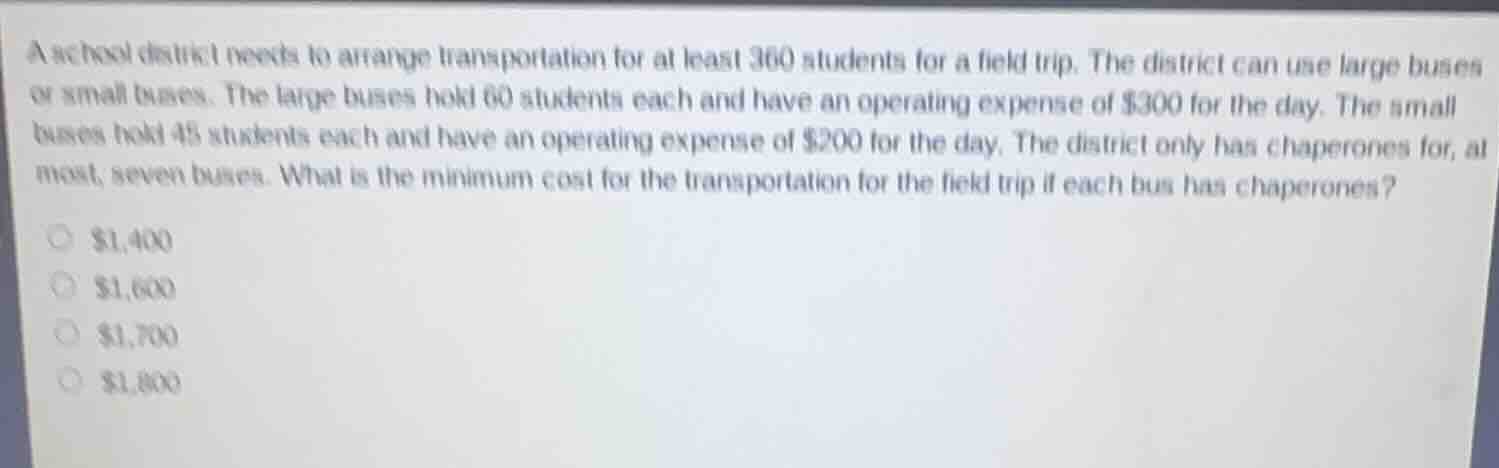
a school district needs to arrange transportation for at least 360 students for a field trip. the district can use large buses or small buses. the large buses hold 60 students each and have an operating expense of $300 for the day. the small buses hold 45 students each and have an operating expense of $200 for the day. the district only has chaperones for, at most, seven buses. what is the minimum cost for the transportation for the field trip if each bus has chaperones?\n$1,400\n$1,600\n$1,700\n$1,800
Answer
Explanation:
Step1: Define variables
Let $x$ = number of large buses, $y$ = number of small buses.
Step2: List constraints
- Student capacity: $60x + 45y \geq 360$ (simplify to $4x + 3y \geq 24$)
- Bus limit: $x + y \leq 7$
- Non-negative integers: $x \geq 0, y \geq 0$
- Cost function: $C = 300x + 200y$ (minimize this)
Step3: Test valid bus combinations
- $x=3, y=4$: $3+4=7$ buses, $603+454=180+180=360$ students. Cost: $3003 + 2004 = 900 + 800 = 1700$
- $x=4, y=3$: $4+3=7$ buses, $604+453=240+135=375$ students. Cost: $3004 + 2003 = 1200 + 600 = 1800$
- $x=6, y=0$: $6+0=6$ buses, $606=360$ students. Cost: $3006=1800$
- $x=2, y=5$: $2+5=7$ buses, $602+455=120+225=345 < 360$ (invalid)
Step4: Compare valid costs
The lowest cost from valid combinations is $1700$.
Answer:
$1,700$