at a science museum, visitors can compete to see who has a faster reaction time. competitors watch a red…
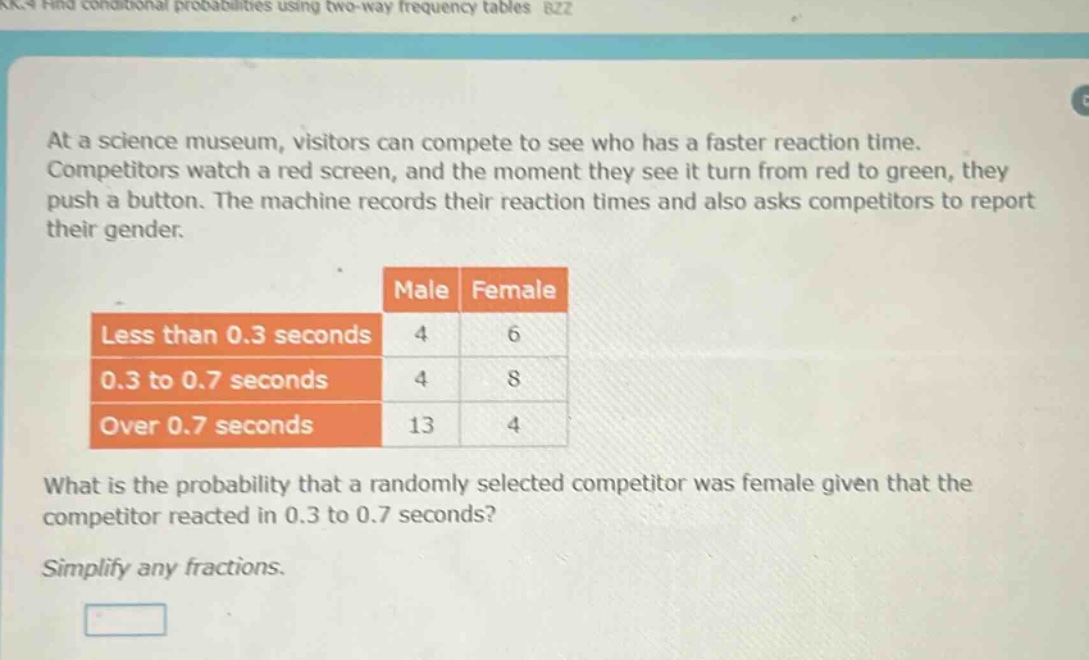
at a science museum, visitors can compete to see who has a faster reaction time. competitors watch a red screen, and the moment they see it turn from red to green, they push a button. the machine records their reaction times and also asks competitors to report their gender.\nmale female\nless than 0.3 seconds 4 6\n0.3 to 0.7 seconds 4 8\nover 0.7 seconds 13 4\nwhat is the probability that a randomly selected competitor was female given that the competitor reacted in 0.3 to 0.7 seconds?\nsimplify any fractions.
Answer
Explanation:
Step1: Find total number of competitors with reaction time 0.3 - 0.7 seconds
Add the number of male and female competitors in the 0.3 - 0.7 seconds range. So, $4 + 8=12$.
Step2: Find number of female competitors with reaction time 0.3 - 0.7 seconds
From the table, the number of female competitors in the 0.3 - 0.7 seconds range is 8.
Step3: Calculate conditional probability
The formula for conditional probability $P(A|B)=\frac{P(A\cap B)}{P(B)}$. In the context of frequency - tables, if $A$ is the event of being female and $B$ is the event of having a reaction time of 0.3 - 0.7 seconds, the probability that a competitor is female given that the competitor reacted in 0.3 - 0.7 seconds is $\frac{\text{Number of females with 0.3 - 0.7 s reaction time}}{\text{Total number of competitors with 0.3 - 0.7 s reaction time}}=\frac{8}{12}=\frac{2}{3}$.
Answer:
$\frac{2}{3}$