a scientist studied the relationship between the number of sunflowers, x, per acre and the number of…
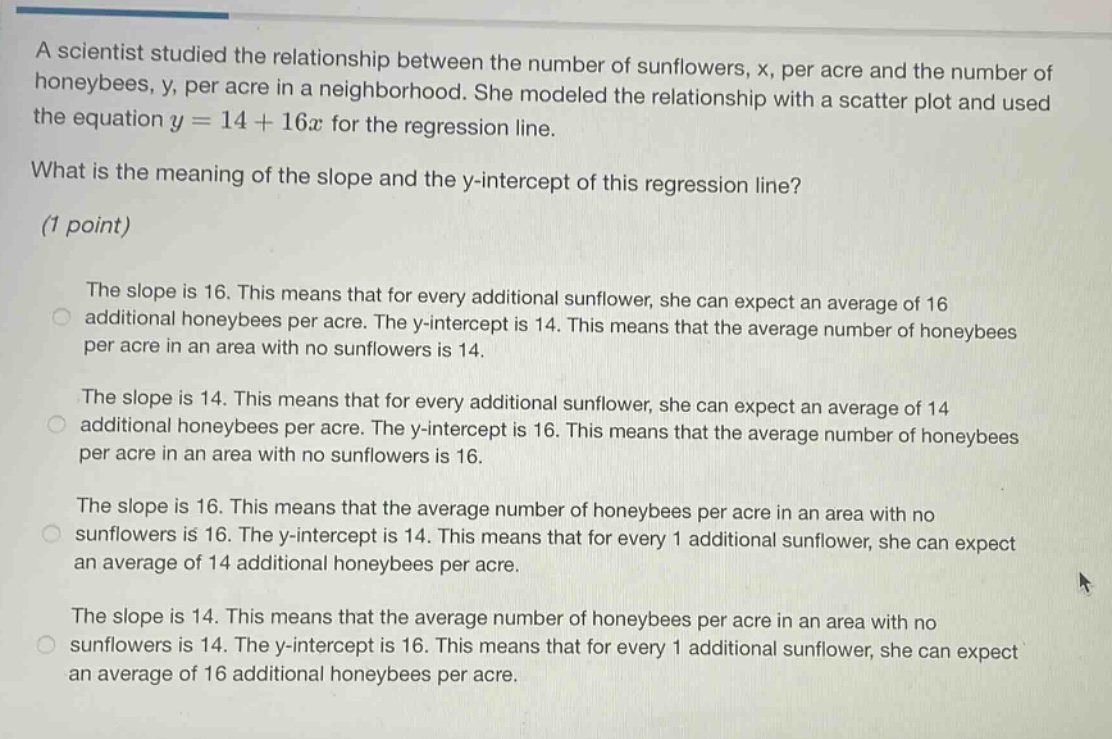
a scientist studied the relationship between the number of sunflowers, x, per acre and the number of honeybees, y, per acre in a neighborhood. she modeled the relationship with a scatter plot and used the equation y = 14 + 16x for the regression line.\nwhat is the meaning of the slope and the y - intercept of this regression line?\n(1 point)\nthe slope is 16. this means that for every additional sunflower, she can expect an average of 16 additional honeybees per acre. the y - intercept is 14. this means that the average number of honeybees per acre in an area with no sunflowers is 14.\nthe slope is 14. this means that for every additional sunflower, she can expect an average of 14 additional honeybees per acre. the y - intercept is 16. this means that the average number of honeybees per acre in an area with no sunflowers is 16.\nthe slope is 16. this means that the average number of honeybees per acre in an area with no sunflowers is 16. the y - intercept is 14. this means that for every 1 additional sunflower, she can expect an average of 14 additional honeybees per acre.\nthe slope is 14. this means that the average number of honeybees per acre in an area with no sunflowers is 14. the y - intercept is 16. this means that for every 1 additional sunflower, she can expect an average of 16 additional honeybees per acre.
Answer
Answer:
The slope is 16. This means that for every additional sunflower, she can expect an average of 16 additional honeybees per acre. The y - intercept is 14. This means that the average number of honeybees per acre in an area with no sunflowers is 14.
Brief Explanations:
In a linear regression equation $y = mx + b$, $m$ (the slope) represents the rate of change of $y$ with respect to $x$. Here, for each unit increase in $x$ (number of sunflowers), $y$ (number of honeybees) increases by 16 on average. The $y$-intercept $b$ is the value of $y$ when $x = 0$, so when there are no sunflowers ($x=0$), the average number of honeybees is 14.