a scientist is studying tulips and daffodils. the scientist estimates that there are 150 tulips in the…
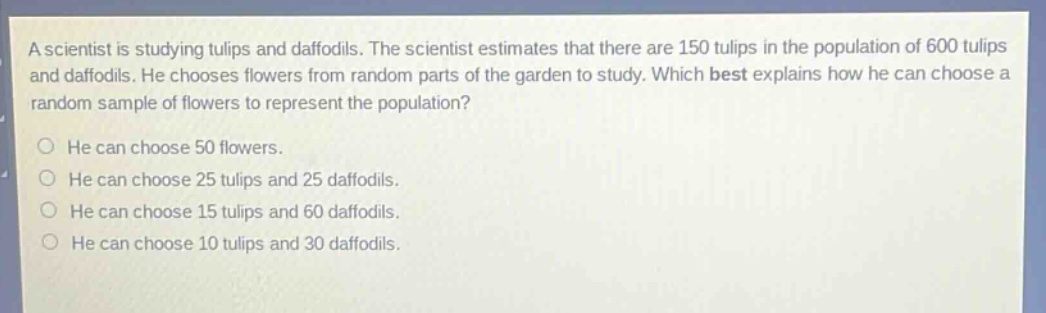
a scientist is studying tulips and daffodils. the scientist estimates that there are 150 tulips in the population of 600 tulips and daffodils. he chooses flowers from random parts of the garden to study. which best explains how he can choose a random sample of flowers to represent the population? he can choose 50 flowers. he can choose 25 tulips and 25 daffodils. he can choose 15 tulips and 60 daffodils. he can choose 10 tulips and 30 daffodils.
Answer
Answer:
He can choose 10 tulips and 30 daffodils.
Explanation:
Step1: Calculate the proportion of tulips and daffodils in the population
The proportion of tulips in the population is $\frac{150}{600}=\frac{1}{4}$, and the proportion of daffodils is $\frac{600 - 150}{600}=\frac{450}{600}=\frac{3}{4}$.
Step2: Check each option
- Option 1: Choosing 50 flowers without considering the proportion of tulips and daffodils.
- Option 2: Choosing 25 tulips and 25 daffodils. The proportion of tulips is $\frac{25}{50}=\frac{1}{2}$, and the proportion of daffodils is $\frac{25}{50}=\frac{1}{2}$, which does not match the population proportion.
- Option 3: Choosing 15 tulips and 60 daffodils. The proportion of tulips is $\frac{15}{75}=\frac{1}{5}$, and the proportion of daffodils is $\frac{60}{75}=\frac{4}{5}$, which does not match the population proportion.
- Option 4: Choosing 10 tulips and 30 daffodils. The proportion of tulips is $\frac{10}{40}=\frac{1}{4}$, and the proportion of daffodils is $\frac{30}{40}=\frac{3}{4}$, which matches the population proportion.