section 1, module 2—harder: reading and writing\n12 mark for review\nneurologists have hypothesized that tau…
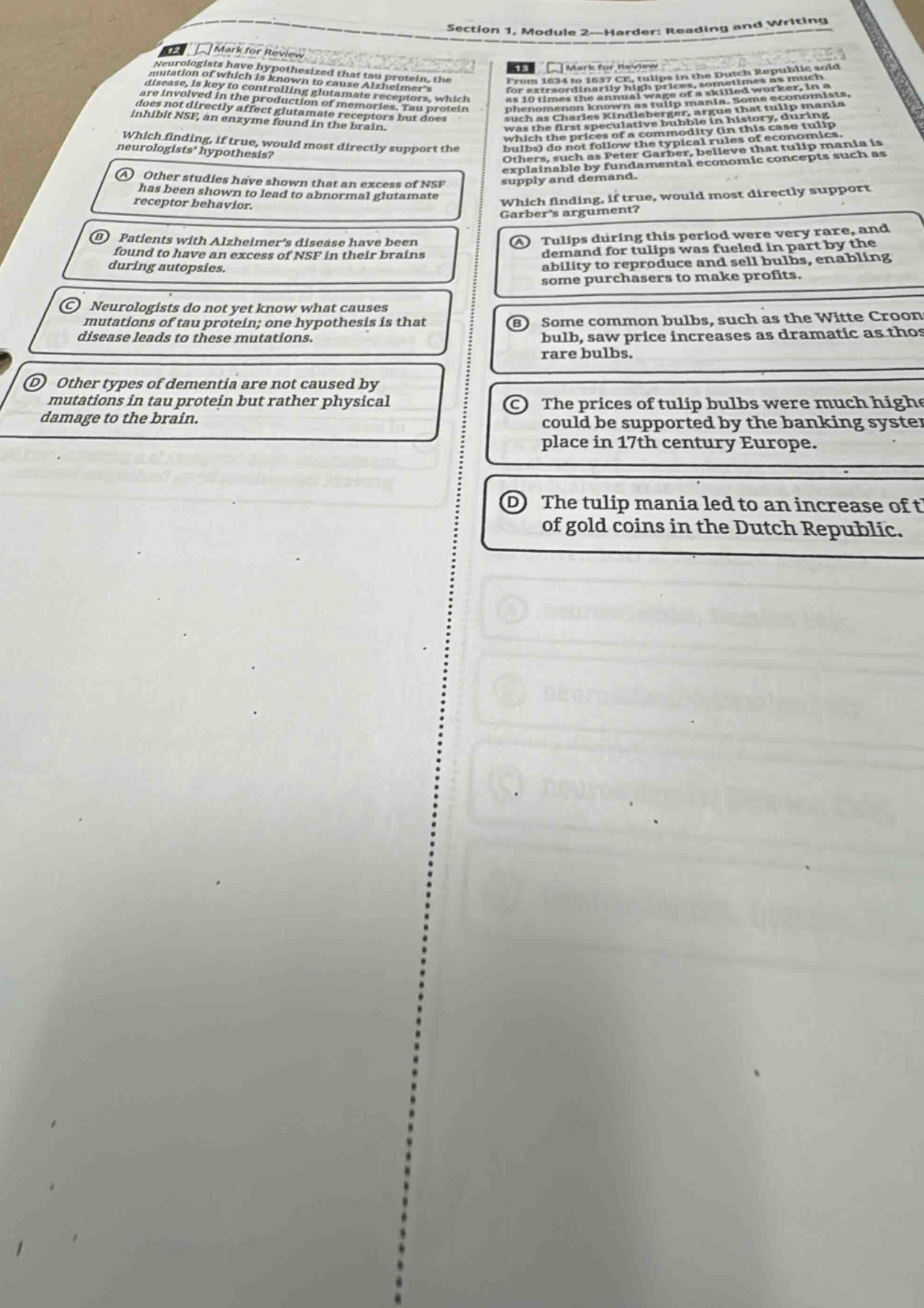
section 1, module 2—harder: reading and writing\n12 mark for review\nneurologists have hypothesized that tau protein, the mutation of which is known to cause alzheimers disease, is key to controlling glutamate receptors, which are involved in the production of memories. tau protein does not directly affect production of memories, but does inhibit nse, an enzyme found in the brain.\nwhich finding, if true, would most directly support the neurologists hypothesis?\na other studies have shown that an excess of nsf has been shown to lead to abnormal glutamate receptor behavior.\nb patients with alzheimers disease have been found to have an excess of nsf in their brains during autopsies.\nc neurologists do not yet know what causes mutations of tau protein; one hypothesis is that disease leads to these mutations.\nd other types of dementia are not caused by mutations in tau protein but rather physical damage to the brain.\n13 mark for review\nfrom 1634 to 1637 ce, tulips in the dutch republic sold for extraordinarily high prices, sometimes as much as ten times the annual wage of a skilled worker, in a phenomenon known as tulip mania. some economists, such as charles kindleberger, argue that tulip mania was the first speculative bubble in history, during which the prices of a commodity (in this case tulip bulbs) do not follow the typical rules of economics.\nothers, such as peter garber, believe that tulip mania is explainable by fundamental economic concepts such as supply and demand.\nwhich finding, if true, would most directly support garbers argument?\na tulips during this period were very rare, and demand for tulips was fueled in part by the ability to reproduce and sell bulbs, enabling some purchasers to make profits.\nb some common bulbs, such as the witte croon bulb, saw price increases as dramatic as those of rare bulbs.\nc the prices of tulip bulbs were much higher than could be supported by the banking system in 17th - century europe.\nd the tulip mania led to an increase of gold coins in the dutch republic.
Answer
Brief Explanations:
For the first question about neurologists' hypothesis on tau - protein and Alzheimer's, option B directly links Alzheimer's patients to an excess of NSF in their brains, which is relevant to the hypothesis. For the second question about Garber's argument that tulip mania can be explained by supply and demand, option A shows that tulips' rarity and demand - driven reproduction support the supply - demand concept.
Answer:
- B. Patients with Alzheimer’s disease have been found to have an excess of NSF in their brains during autopsies.
- A. Tulips during this period were very rare, and demand for tulips was fueled in part by the ability to reproduce and sell bulbs, enabling some purchasers to make profits.