a 4 - section spinner is spun 2 times. each of the sections are the same size.\nthe set of possible outcomes…
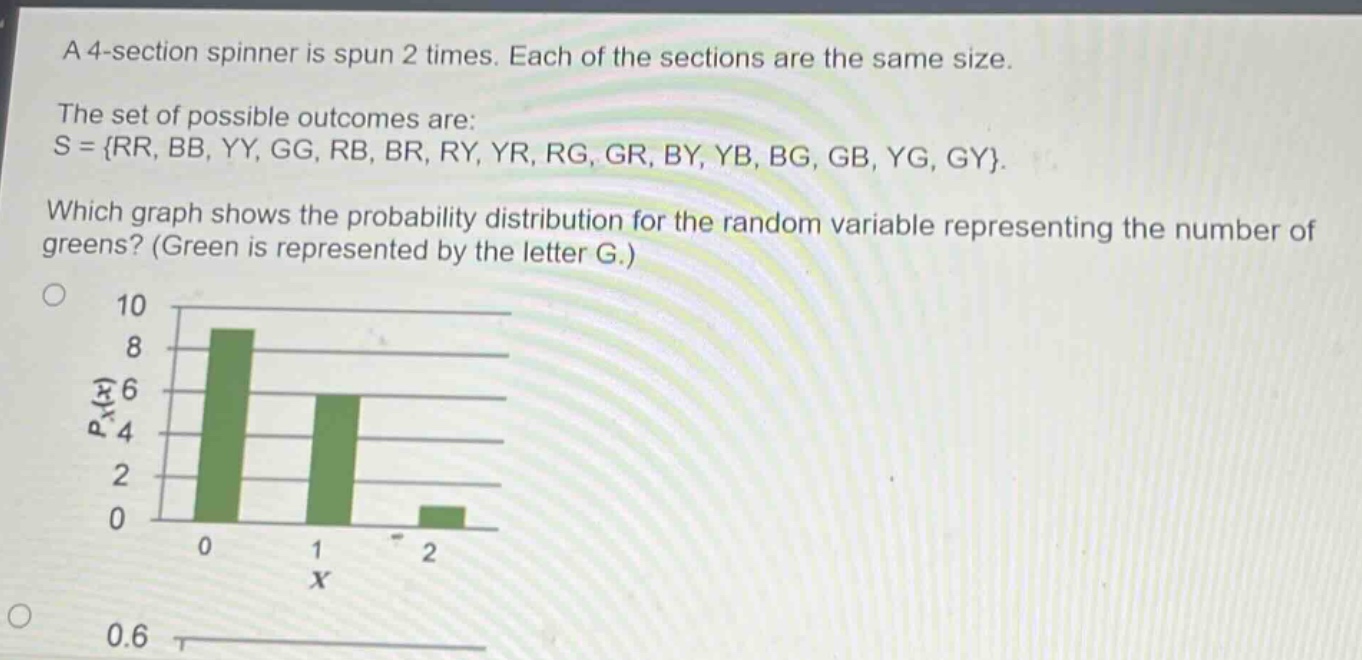
a 4 - section spinner is spun 2 times. each of the sections are the same size.\nthe set of possible outcomes are:\ns = {rr, bb, yy, gg, rb, br, ry, yr, rg, gr, by, yb, bg, gb, yg, gy}.\nwhich graph shows the probability distribution for the random variable representing the number of greens? (green is represented by the letter g.)
Answer
Answer:
We first need to find the probabilities of having 0, 1, and 2 greens. The total number of possible outcomes when spinning the 4 - section spinner 2 times is (n(S)=16).
- Probability of 0 greens ((P(X = 0))):
- The outcomes with 0 greens are ({RR, BB, YY, RB, BR, RY, YR, BY, YB}). The number of such outcomes (n(0)=9). So (P(X = 0)=\frac{9}{16}= 0.5625).
- Probability of 1 green ((P(X = 1))):
- The outcomes with 1 green are ({RG, GR, BG, GB, YG, GY}). The number of such outcomes (n(1)=6). So (P(X = 1)=\frac{6}{16}=0.375).
- Probability of 2 greens ((P(X = 2))):
- The outcome with 2 greens is ({GG}). The number of such outcomes (n(2)=1). So (P(X = 2)=\frac{1}{16}=0.0625).
We need to check which graph has (P(X = 0)\approx0.5625), (P(X = 1)=0.375) and (P(X = 2)=0.0625). Since the problem only provides one partial - graph, we can't fully answer which graph is correct based on the given information. But if we assume we are comparing the relative heights of the bars for (X = 0), (X = 1) and (X = 2), the bar for (X = 0) should be the tallest, followed by the bar for (X = 1) and then the bar for (X = 2) should be the shortest.
Explanation:
Step1: Calculate total outcomes
The spinner has 4 sections and is spun 2 times. By the multiplication principle, the total number of outcomes (n = 4\times4=16).
Step2: Count outcomes for (X = 0)
Count non - green outcomes: 9 non - green combinations. So (P(X = 0)=\frac{9}{16}).
Step3: Count outcomes for (X = 1)
Count outcomes with one green: 6 one - green combinations. So (P(X = 1)=\frac{6}{16}).
Step4: Count outcomes for (X = 2)
Count outcomes with two greens: 1 two - green combination. So (P(X = 2)=\frac{1}{16}).