section 8.3 testing the difference between means (dependent samples) 443\n11. caffeine ingestion a…
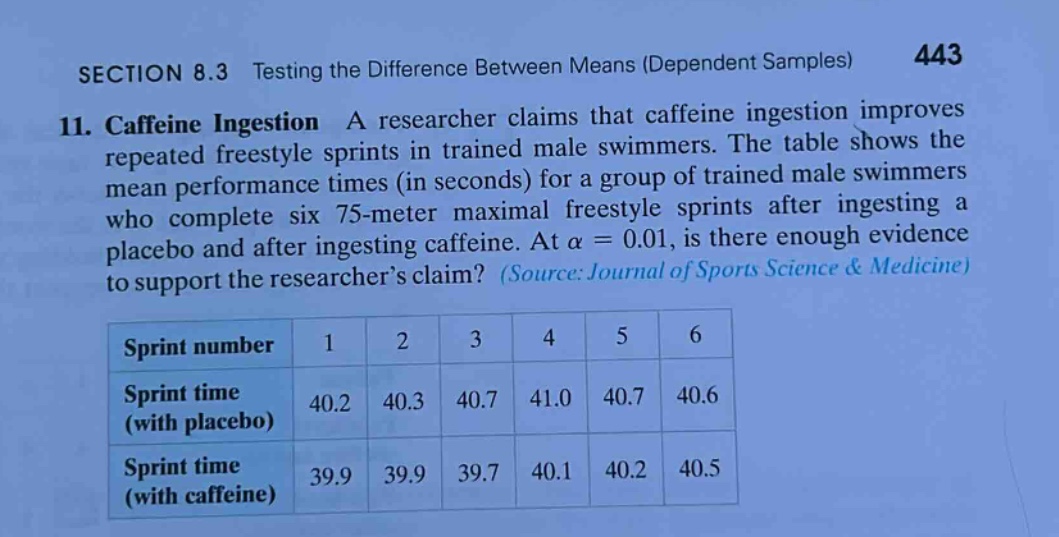
section 8.3 testing the difference between means (dependent samples) 443\n11. caffeine ingestion a researcher claims that caffeine ingestion improves repeated freestyle sprints in trained male swimmers. the table shows the mean performance times (in seconds) for a group of trained male swimmers who complete six 75 - meter maximal freestyle sprints after ingesting a placebo and after ingesting caffeine. at $alpha = 0.01$, is there enough evidence to support the researchers claim? (source: journal of sports science & medicine)\nsprint number 1 2 3 4 5 6\nsprint time (with placebo) 40.2 40.3 40.7 41.0 40.7 40.6\nsprint time (with caffeine) 39.9 39.9 39.7 40.1 40.2 40.5
Answer
Explanation:
Step1: Calculate the differences
Let $d_i$ be the difference between the sprint - time with placebo and the sprint - time with caffeine for each sprint. $d_1=40.2 - 39.9=0.3$, $d_2=40.3 - 39.9 = 0.4$, $d_3=40.7-39.7 = 1.0$, $d_4=41.0 - 40.1=0.9$, $d_5=40.7 - 40.2 = 0.5$, $d_6=40.6 - 40.5=0.1$.
Step2: Calculate the mean of the differences $\bar{d}$
$\bar{d}=\frac{\sum_{i = 1}^{6}d_i}{n}$, where $n = 6$ and $\sum_{i=1}^{6}d_i=0.3 + 0.4+1.0 + 0.9+0.5+0.1=3.2$. So, $\bar{d}=\frac{3.2}{6}\approx0.533$.
Step3: Calculate the standard deviation of the differences $s_d$
First, calculate $(d_i-\bar{d})^2$ for each $i$: $(d_1 - \bar{d})^2=(0.3 - 0.533)^2=(- 0.233)^2 = 0.0543$, $(d_2-\bar{d})^2=(0.4 - 0.533)^2=(-0.133)^2 = 0.0177$, $(d_3-\bar{d})^2=(1.0 - 0.533)^2=(0.467)^2 = 0.2181$, $(d_4-\bar{d})^2=(0.9 - 0.533)^2=(0.367)^2 = 0.1347$, $(d_5-\bar{d})^2=(0.5 - 0.533)^2=(-0.033)^2 = 0.0011$, $(d_6-\bar{d})^2=(0.1 - 0.533)^2=(-0.433)^2 = 0.1875$. $\sum_{i = 1}^{6}(d_i-\bar{d})^2=0.0543+0.0177 + 0.2181+0.1347+0.0011+0.1875 = 0.6134$. $s_d=\sqrt{\frac{\sum_{i = 1}^{6}(d_i-\bar{d})^2}{n - 1}}=\sqrt{\frac{0.6134}{5}}\approx0.35$.
Step4: Calculate the test - statistic $t$
The null hypothesis $H_0:\mu_d\leq0$ and the alternative hypothesis $H_1:\mu_d>0$. The test - statistic $t=\frac{\bar{d}-\mu_d}{s_d/\sqrt{n}}$, with $\mu_d = 0$ (under $H_0$), $n = 6$, $\bar{d}\approx0.533$, and $s_d\approx0.35$. $t=\frac{0.533-0}{0.35/\sqrt{6}}\approx3.73$.
Step5: Determine the critical value
The degrees of freedom $df=n - 1=6 - 1 = 5$. For a one - tailed test with $\alpha=0.01$ and $df = 5$, the critical value $t_{\alpha,df}=t_{0.01,5}=3.365$.
Step6: Make a decision
Since the calculated $t\approx3.73>t_{0.01,5}=3.365$, we reject the null hypothesis.
Answer:
Yes, there is enough evidence at the $\alpha = 0.01$ level of significance to support the researcher's claim that caffeine ingestion improves repeated freestyle sprints in trained male swimmers.