select the correct answer.\naudrey has a box that contains one caramel chocolate (c), one milk chocolate…
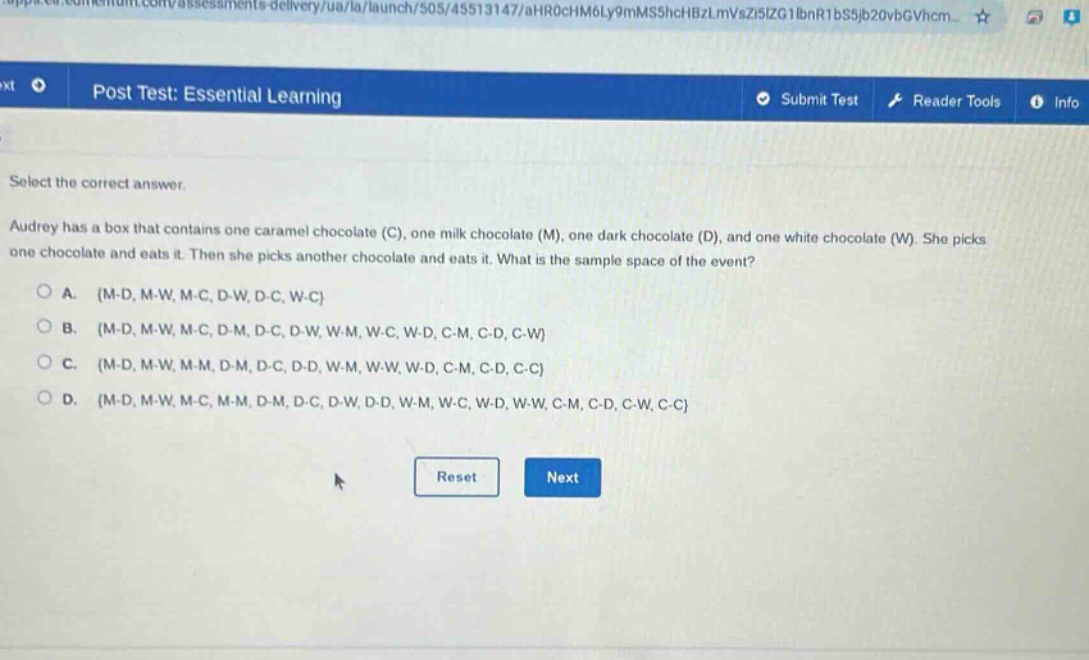
select the correct answer.\naudrey has a box that contains one caramel chocolate (c), one milk chocolate (m), one dark chocolate (d), and one white chocolate (w). she picks one chocolate and eats it. then she picks another chocolate and eats it. what is the sample space of the event?\n○ a. {m - d, m - w, m - c, d - w, d - c, w - c}\n○ b. {m - d, m - w, m - c, d - m, d - c, d - w, w - m, w - c, w - d, c - m, c - d, c - w}\n○ c. {m - d, m - w, m - m, d - m, d - c, d - d, w - m, w - w, w - d, c - m, c - d, c - c}\n○ d. {m - d, m - w, m - c, m - m, d - m, d - c, d - w, d - d, w - m, w - c, w - d, w - w, c - m, c - d, c - w, c - c}
Answer
Explanation:
Step1: Calculate the number of possible outcomes for the first pick
There are 4 chocolates. So, there are 4 possible outcomes for the first pick.
Step2: Calculate the number of possible outcomes for the second pick
Since one chocolate is already eaten (no - replacement), there are 3 possible outcomes for the second pick.
Step3: Calculate the total number of elements in the sample space
By the multiplication principle, the total number of elements in the sample space is (n = 4\times3=12)
Now, let's list out all the possible pairs: When the first pick is (M) (milk chocolate):
- If first is (M), second can be (D) ((M - D)), (W) ((M - W)), (C) ((M - C)) When the first pick is (D) (dark chocolate):
- If first is (D), second can be (M) ((D - M)), (W) ((D - W)), (C) ((D - C)) When the first pick is (W) (white chocolate):
- If first is (W), second can be (M) ((W - M)), (D) ((W - D)), (C) ((W - C)) When the first pick is (C) (caramel chocolate):
- If first is (C), second can be (M) ((C - M)), (D) ((C - D)), (W) ((C - W))
The sample space is ({M - D,M - W,M - C,D - M,D - C,D - W,W - M,W - C,W - D,C - M,C - D,C - W})
Answer:
B. ({M - D,M - W,M - C,D - M,D - C,D - W,W - M,W - C,W - D,C - M,C - D,C - W})