select the correct answer. based on the data in this two - way table, which statement is true?\n|type of…
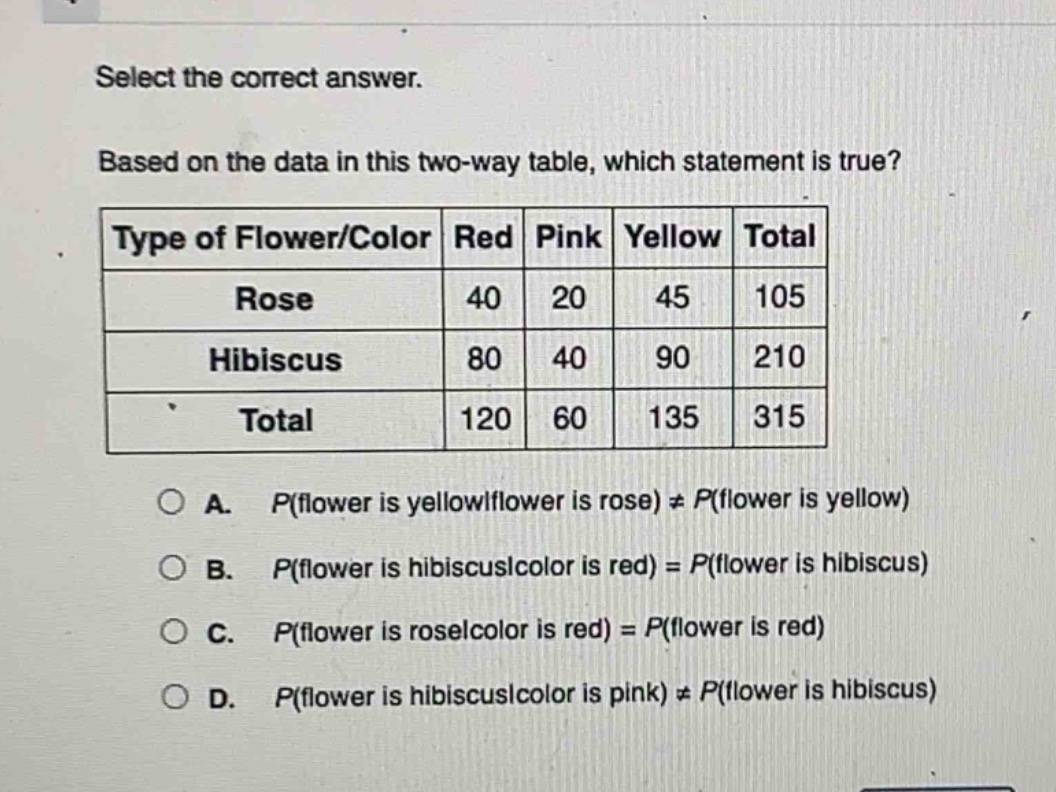
select the correct answer. based on the data in this two - way table, which statement is true?\n|type of flower/color|red|pink|yellow|total|\n|----|----|----|----|----|\n|rose|40|20|45|105|\n|hibiscus|80|40|90|210|\n|total|120|60|135|315|\na. (p(\text{flower is yellow}|\text{flower is rose})\neq p(\text{flower is yellow}))\nb. (p(\text{flower is hibiscus}|\text{color is red}) = p(\text{flower is hibiscus}))\nc. (p(\text{flower is rose}|\text{color is red}) = p(\text{flower is red}))\nd. (p(\text{flower is hibiscus}|\text{color is pink})\neq p(\text{flower is hibiscus}))
Answer
Explanation:
Step1: Recall conditional - probability formula
The formula for conditional probability is $P(A|B)=\frac{P(A\cap B)}{P(B)}=\frac{n(A\cap B)}{n(B)}$, where $n(A\cap B)$ is the number of elements in the intersection of $A$ and $B$, and $n(B)$ is the number of elements in $B$.
Step2: Calculate $P(\text{flower is yellow}|\text{flower is rose})$
$P(\text{flower is yellow}|\text{flower is rose})=\frac{\text{Number of yellow roses}}{\text{Number of roses}}=\frac{45}{105}=\frac{3}{7}$
Step3: Calculate $P(\text{flower is yellow})$
$P(\text{flower is yellow})=\frac{\text{Number of yellow flowers}}{\text{Total number of flowers}}=\frac{135}{315}=\frac{3}{7}$
Step4: Calculate $P(\text{flower is hibiscus}|\text{color is red})$
$P(\text{flower is hibiscus}|\text{color is red})=\frac{\text{Number of red hibiscuses}}{\text{Number of red flowers}}=\frac{80}{120}=\frac{2}{3}$
Step5: Calculate $P(\text{flower is hibiscus})$
$P(\text{flower is hibiscus})=\frac{\text{Number of hibiscuses}}{\text{Total number of flowers}}=\frac{210}{315}=\frac{2}{3}$
Step6: Calculate $P(\text{flower is rose}|\text{color is red})$
$P(\text{flower is rose}|\text{color is red})=\frac{\text{Number of red roses}}{\text{Number of red flowers}}=\frac{40}{120}=\frac{1}{3}$
Step7: Calculate $P(\text{flower is red})$
$P(\text{flower is red})=\frac{\text{Number of red flowers}}{\text{Total number of flowers}}=\frac{120}{315}=\frac{8}{21}$
Step8: Calculate $P(\text{flower is hibiscus}|\text{color is pink})$
$P(\text{flower is hibiscus}|\text{color is pink})=\frac{\text{Number of pink hibiscuses}}{\text{Number of pink flowers}}=\frac{40}{60}=\frac{2}{3}$
Step9: Calculate $P(\text{flower is hibiscus})$
$P(\text{flower is hibiscus})=\frac{210}{315}=\frac{2}{3}$
Answer:
B. $P(\text{flower is hibiscus}|\text{color is red}) = P(\text{flower is hibiscus})$