select the correct answer.\nconsider the following data set:\n5, 33, 25, 55, 96, 75, 23, 69, 37, 17, 12.\na…
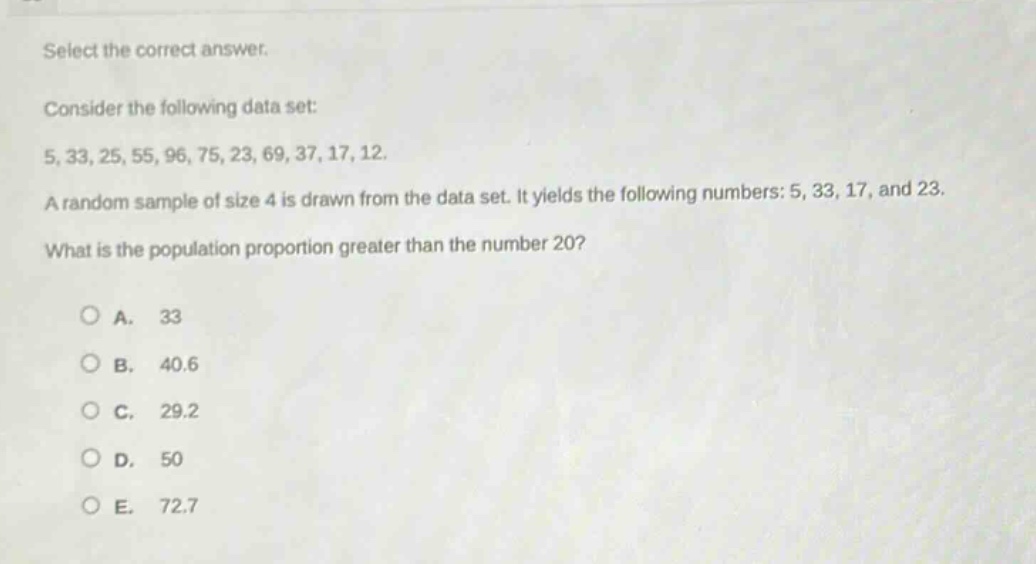
select the correct answer.\nconsider the following data set:\n5, 33, 25, 55, 96, 75, 23, 69, 37, 17, 12.\na random sample of size 4 is drawn from the data set. it yields the following numbers: 5, 33, 17, and 23.\nwhat is the population proportion greater than the number 20?\n\na. 33\nb. 40.6\nc. 29.2\nd. 50\ne. 72.7
Answer
Explanation:
Step1: Count population size
The population data - set is 5, 33, 25, 55, 96, 75, 23, 69, 37, 17, 12. The population size $N = 11$.
Step2: Count number of elements greater than 20
The numbers greater than 20 in the population are 33, 25, 55, 96, 75, 23, 69, 37. The number of such elements $n=8$.
Step3: Calculate population proportion
The population proportion $p=\frac{n}{N}=\frac{8}{11}\approx0.727$. To convert to percentage, we multiply by 100, so $p = 72.7%$.
Answer:
E. 72.7